Hemp Hearts vs Hemp Seeds: What’s the Difference? (Nutrition & Uses)

The hemp hearts vs hemp seeds question comes up often: they come from the same plant, so what is the actual difference? Walk into any health food store or browse a bulk ingredient catalog, and you will find both forms. To a first-time buyer, the difference might seem minor, but the distinction matters for nutrition, texture, price, and what you can actually do with each form in the kitchen or on a production line.
At Nordic Hemp, we process both every day at our facility in Estonia. This hemp hearts vs hemp seeds guide breaks down exactly how they compare, what each is best for, and why the price difference exists. For a complete breakdown of their nutritional value, see our guide on what makes hemp hearts so healthy.
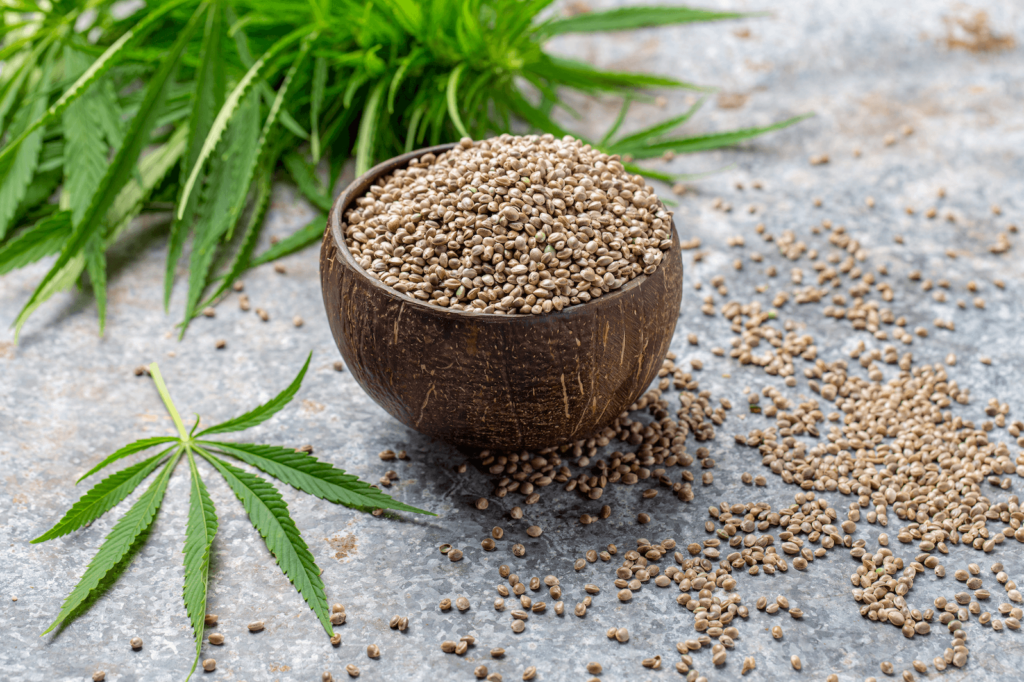
Hemp hearts are the soft inner kernel of the hemp seed with the hard outer hull removed. Whole hemp seeds still have the fibrous shell intact. Because the hull is gone, hemp hearts contain about 13% more protein and 10% more fat per gram than whole seeds, while whole seeds have roughly 3x more fiber. Both have a shelf life of 24 months and THC and CBD are naturally present at trace levels, well below the EU limit of 3 mg/kg.
Are hemp hearts the same as hemp seeds?
No. The hemp hearts vs hemp seeds difference is simple: hemp hearts — also called hulled hemp seeds, shelled hemp seeds, or hemp kernels — are what remains after the hard outer hull has been mechanically removed. Whole hemp seeds still have the shell on.
The hull makes up roughly 35% of the seed by weight and consists mainly of fiber. When you remove it, you concentrate the protein and fat that live in the kernel. That is why hemp hearts are more nutrient-dense per gram, while whole seeds offer more fiber and a crunchier texture.
You might also hear the terms “shelled hemp seeds,” “de-shelled hemp seeds,” or “hemp nuts” — they all mean the same thing as hemp hearts.
Which has more protein: hemp hearts or hemp seeds?
Hemp hearts have more protein per 100g. Our lab-verified specification shows 34g of protein per 100g in hemp hearts, compared to 30g in whole hemp seeds — a difference of about 13%.
The reason is straightforward: protein is concentrated in the inner kernel. When you remove the hull, which is mostly fiber, the remaining kernel has a higher protein percentage by weight.
A 2026 study in Frontiers in Nutrition confirmed that de-hulling concentrates protein, finding crude protein levels of 33.78% in hulled seeds versus 25.14% in whole seeds. Our Estica, RAK and Finola varieties show higher whole-seed protein (30g per 100g) due to cultivar selection and Nordic growing conditions.
Protein quality is also better in hemp hearts. The PDCAAS score (a measure of protein digestibility and amino acid completeness) is 0.63–0.66 for hemp hearts compared to 0.49–0.53 for whole seeds. Both contain all nine essential amino acids, but the body absorbs the protein from hemp hearts more efficiently.
If your product needs high protein per serving — protein bars, smoothie powders, plant-based milk — hemp hearts are the better choice. For a deeper breakdown of the amino acid profile, see our complete protein guide for hemp hearts.
Which has more fiber: hemp hearts or hemp seeds?
Whole hemp seeds win on fiber, and by a wide margin. The hull is roughly 35–40% fiber, so when it stays on the seed, the fiber content is much higher. Whole hemp seeds contain approximately 25g of crude fiber per 100g, while hemp hearts contain about 8g per 100g — roughly three times less.
For digestive health, gut health, and products where fiber content is a selling point, whole seeds are the better option. For applications where a smooth texture or high protein density matters more, hemp hearts are preferable.
Nutritional comparison: hemp hearts vs whole hemp seeds
Here is a side-by-side comparison per 100g, based on our product specifications and published research:
| Nutrient (per 100g) | Hemp Hearts | Whole Seeds |
|---|---|---|
| Protein | 34 g | 30 g |
| Fat | 48.2 g | 43.9 g |
| Crude fiber | ~8 g | ~25 g |
| Energy | 575 kcal | 575 kcal |
| Carbohydrates | 5–7 g | 23.3 g |
| Moisture | 6.5–8% | ~7% |
| PDCAAS | 0.63–0.66 | 0.49–0.53 |
| Phytic acid | 202 mg | 428 mg |
| Shelf life | 24 months | 24 months |
Source: Nordic Hemp product specifications and Frontiers in Nutrition (2026). PDCAAS values from House et al., Journal of Agricultural and Food Chemistry.
Phytic acid binds to minerals like iron, zinc, and calcium, making them harder for the body to absorb. Hemp hearts contain about half as much phytic acid as whole seeds (202 mg vs 428 mg per 100g), which means the minerals in hemp hearts are more bioavailable.
Taste and texture: how do they differ?
The difference in taste is subtle but real. Both have a mild, nutty flavour, but hemp hearts are sweeter and creamier because the bitter compounds in the hull are gone. Whole hemp seeds have a more earthy, slightly grassy taste from the shell.
Texture is where the difference is most noticeable. Hemp hearts are soft — almost buttery when chewed. They blend smoothly into smoothies, disappear into batters, and add creaminess without crunch. Whole hemp seeds are crunchy and fibrous. They add a satisfying bite to salads, granola, and toppings.
Unlike chia or flax seeds, neither form absorbs water. Hemp hearts and whole seeds both maintain their texture in food products without forming a gel, which makes them easier to work with in formulations.
Which should you choose?
The answer depends on what you are making. Here is a practical guide based on what we see from our B2B customers and what the nutritional data supports:
- High protein density per serving
- Smooth texture (smoothies, bars, milks)
- Better mineral absorption
- Clean-label, allergen-free protein
- Higher protein quality (PDCAAS 0.63–0.66)
- High fiber content (gut health)
- Crunchy texture (granola, toppings)
- Lower cost per kilogram
- Polyphenol antioxidants from the hull
- A longer “whole food” ingredient list
Many of our customers use both — whole seeds in granola and crunchy products, hemp hearts in protein bars and smoothie powders. At Nordic Hemp we handle both from the same Estica, RAK and Finola varieties grown in Estonia. RAK is our newest variety, registered in the EU Common Catalogue in 2025 — we are the sole official distributor of RAK planting seeds in the EU.
How does de-hulling change the seed?
The de-hulling process is entirely mechanical — no chemicals, no heat, no solvents. At our facility, cleaned whole seeds pass through a de-huller that gently cracks the shell and separates it from the kernel. Optical sorting then removes any remaining shell fragments.
Do both forms contain THC?
Both THC and CBD are naturally present in hemp hearts and whole hemp seeds at trace levels. THC is regularly tested and stays below the EU legal limit of 3 mg/kg for seeds — most of our batches test at 0.1 mg/kg to below 3 mg/kg, and some are non-detected. To put this in perspective: the field-level THC limit for hemp is 2000 mg/kg — a very different threshold than the 3 mg/kg limit for seeds.
For a full breakdown of the EU THC regulations for hemp seeds, see our detailed guide: All you need to know about new THC regulations in EU from 01.2023.
The THC that exists in the hemp plant is concentrated in the leaves and flowers, not in the seeds. During harvesting and cleaning, any residual plant material is removed. Neither form will make you high, and both are safe for daily consumption.
Price difference: are hemp hearts more expensive?
Yes — hemp hearts are more expensive per kilogram than whole seeds. The price difference comes from the processing itself: the de-hulling process is an additional production step, and roughly 35% of the seed weight is removed as hull. During de-hulling we also remove the fine green particle between the shell and the kernel — what we sell as smoothie hemp — which further reduces the yield of finished hemp hearts.
In other words, the price reflects the extra handling, sorting, and the weight lost during processing, not a difference in the raw material itself. For food manufacturers, the choice between hearts and whole seeds depends on the application — texture, nutrition profile, and end-product requirements — rather than a simple cost comparison.
For food manufacturers sourcing in bulk, the exact price depends on volume, packaging, and whether you need organic or conventional. You can request a quote here.
Looking for bulk hemp hearts or whole seeds?
We supply both in bulk to food manufacturers across Europe. Get a quote within one business day.
Request a quote →Common questions about hemp hearts vs hemp seeds
Which has more protein?
Hemp hearts have more protein per 100g: approximately 34g compared to 30g in whole hemp seeds. The protein quality is also higher in hemp hearts, with a PDCAAS score of 0.63–0.66 versus 0.49–0.53 in whole seeds.
Which has more fiber?
Whole hemp seeds have significantly more fiber — approximately 25g per 100g compared to about 8g in hemp hearts. The fiber is concentrated in the hull, which is removed during the de-hulling process that produces hemp hearts.
Are hemp hearts better for you than whole seeds?
It depends on what you need. Hemp hearts are higher in protein, lower in phytic acid (better mineral absorption), and have a creamier texture. Whole seeds are higher in fiber, contain polyphenol antioxidants from the hull, and are typically less expensive. Both are nutritious — which is “better” depends on your goals.
How long do they last?
Both have a shelf life of 24 months when stored properly. Hemp hearts are more susceptible to oxidation. The hull removal exposes the kernel’s fats. Cool, dry storage, protected from sunlight, maintains freshness.
Can I substitute one for the other in recipes?
It depends on the recipe. If you are using them as a topping or in baked goods where texture matters, the difference will be noticeable — whole seeds add crunch, hearts add creaminess. If you are blending them into a smoothie or protein powder, you can adjust the amount to match the protein content and get a similar result.