How Much Protein in Hemp Hearts? Complete Amino Acid Profile Per 100g
By Sander Kuusk · Updated July 23, 2026
How Much Protein in Hemp Hearts? Complete Amino Acid Profile Per 100g
Hemp hearts contain 34g of protein per 100g — more than whole hemp seeds (30g), chia seeds (17g), or flax seeds (18g). If you are wondering how much protein in hemp hearts is usable by the body, the answer is that they provide all nine essential amino acids your body cannot produce on its own, making them a complete plant protein. The PDCAAS score of 0.63–0.66 reflects good digestibility. The low phytic acid content (202 mg per 100g) means the minerals and amino acids are more bioavailable than in many other seeds. For the full picture on why hemp hearts are considered a superfood, read our in-depth guide.
How much protein is in hemp hearts exactly?
To answer how much protein in hemp hearts you can expect: according to our lab-verified product specifications, organic hemp hearts contain 34g of protein per 100g. They are one of the most protein-dense seeds available. For context, here is how they compare is how they compare:
| Source (per 100g) | Protein | Complete protein? |
|---|---|---|
| Hemp hearts (Nordic Hemp) | 34 g | Yes — all 9 EAAs |
| Whole hemp seeds | 30 g | Yes — all 9 EAAs |
| Chia seeds | 17 g | No — limited lysine |
| Flax seeds | 18 g | No — limited lysine |
| Soybeans (cooked) | 16 g | Yes — all 9 EAAs |
| Pea protein isolate (typical) | 80 g | No — limited methionine |
| Whey protein isolate (typical) | 90 g | Yes — all 9 EAAs |
Sources: Nordic Hemp product specifications (hemp hearts, whole seeds). USDA FoodData Central (chia, flax, soy). Pea and whey values are industry averages for isolates — whole food sources differ significantly.
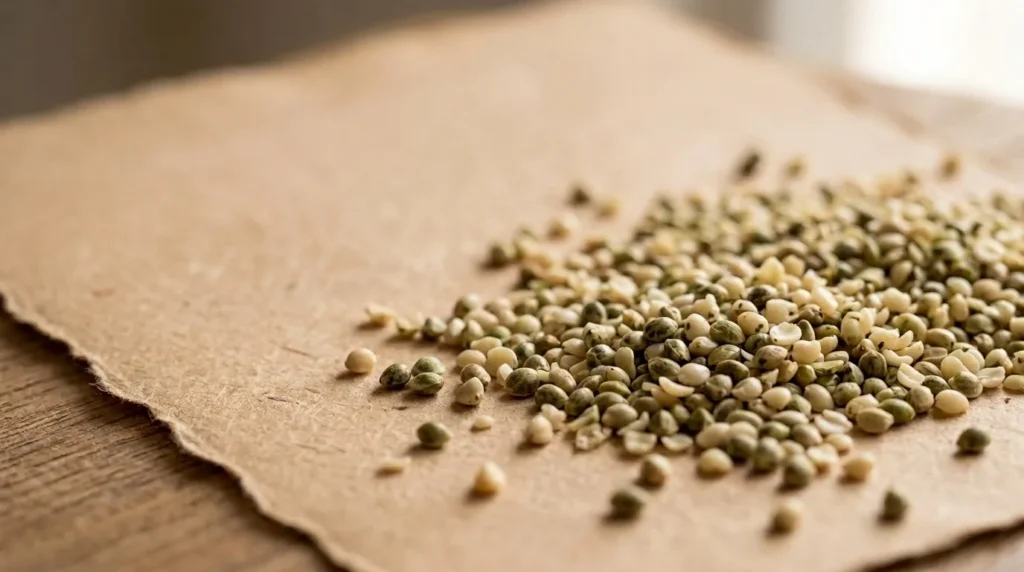
A 2026 study in Frontiers in Nutrition confirmed that de-hulling concentrates protein, finding crude protein levels of 33.78% in hulled hemp seeds versus 25.14% in whole seeds. Our Estica, RAK and Finola varieties show higher whole-seed protein (30g per 100g) due to cultivar selection and Nordic growing conditions.
When comparing protein sources for your product formulation, remember that hemp hearts are a whole food ingredient — not an isolate. The 34g protein per 100g includes the full fat and fibre profile, which contributes to texture, mouthfeel, and nutritional labelling. If you are comparing against protein isolates (pea, soy, whey), adjust for the serving size that fits your application rather than comparing protein density alone.
What is the complete amino acid profile of hemp hearts?
Beyond the question of how much protein in hemp hearts, the quality of that protein matters. Hemp hearts contain all nine essential amino acids (EAAs) — the ones the human body cannot synthesise and must obtain from food. This is relatively rare among plant proteins; many plant sources are missing or low in one or more essential amino acids, particularly lysine or methionine.
| Essential amino acid | mg per 100g hemp hearts | Role in the body |
|---|---|---|
| Leucine | 2,010 mg | Muscle protein synthesis, repair |
| Valine | 1,610 mg | Muscle metabolism, tissue repair |
| Isoleucine | 1,320 mg | Energy regulation, haemoglobin |
| Phenylalanine | 1,310 mg | Neurotransmitter production |
| Lysine | 1,110 mg | Collagen formation, calcium absorption |
| Threonine | 1,020 mg | Immune function, gut health |
| Histidine | 820 mg | Tissue growth, immune response |
| Methionine | 550 mg | Detoxification, antioxidant defence |
| Tryptophan | 390 mg | Serotonin production, sleep regulation |
Amino acid values are approximate and based on published research for hulled hemp seeds (Callaway, 2004; House et al., 2010; FMC, 2020). Actual values may vary by variety, harvest year, and growing conditions.
What makes hemp hearts a “complete” protein?
A protein is considered complete when it supplies all nine essential amino acids in sufficient amounts for human health. Most plant proteins fall short in one category — grains lack lysine, legumes lack methionine — which is why the classic advice is to combine them. Hemp hearts are unusual among plant foods because they provide a balanced profile of all nine EAAs on their own, without needing to be paired with another protein source.
The limiting amino acid in hemp hearts is lysine, but at 1,110 mg per 100g, the level is still sufficient to support the standard adult requirement of approximately 30 mg per kg of body weight per day. For a 70 kg adult, just 30–40g of hemp hearts covers roughly a third of the daily lysine requirement.
PDCAAS: how digestible is hemp heart protein?
PDCAAS (Protein Digestibility-Corrected Amino Acid Score) is the standard method used by the FAO and WHO to evaluate protein quality. It measures both the amino acid profile and how well the body can digest and absorb those amino acids. A score of 1.0 means the protein meets all requirements perfectly — like egg white or casein.
| Protein source | PDCAAS score |
|---|---|
| Egg white | 1.00 |
| Whey protein | 1.00 |
| Soy protein isolate | 0.95–1.00 |
| Hemp hearts | 0.63–0.66 |
| Whole hemp seeds | 0.49–0.53 |
| Pea protein | 0.69–0.73 |
| Brown rice protein | 0.48–0.58 |
| Wheat gluten | 0.25–0.45 |
PDCAAS values from House et al., Journal of Agricultural and Food Chemistry (2010), and Hughes et al., Journal of Agricultural and Food Chemistry (2011).
The PDCAAS of 0.63–0.66 for hemp hearts is strong for a plant protein that is not an isolate. By comparison, whole hemp seeds score 0.49–0.53. De-hulling concentrates protein and improves digestibility. The fibre-dense hull, which can interfere with amino acid absorption, is removed.erfere with amino acid absorption.
The PDCAAS score matters most when hemp hearts are the sole protein source in a product. In most applications — protein bars, smoothie powders, plant-based milks — hemp hearts are blended with other ingredients that contribute complementary amino acids. In practice, the effective protein quality in a finished product is often higher than the standalone PDCAAS.
How to use hemp hearts for protein in food manufacturing
Hemp hearts integrate easily into existing production lines because they require no grinding, hydration, or pre-processing. Here are typical inclusion rates based on our B2B clients’ usage:
| Application | Typical inclusion rate | Protein per serving |
|---|---|---|
| Protein bars | 10–15% | 3.4–5.1g per 100g bar |
| Smoothie powders | 20–30% | 6.8–10.2g per 30g serve |
| Plant-based milk | 5–8% | 1.7–2.7g per 100ml |
| Baked goods | 8–12% | 2.7–4.1g per 100g |
| Granola / muesli | 5–10% | 1.7–3.4g per 100g |
Inclusion rates are industry averages from B2B manufacturing. Optimal levels depend on final product texture, taste, and nutritional targets.
Common questions about hemp heart protein
How much protein is in a tablespoon of hemp hearts?
A tablespoon of hemp hearts weighs approximately 10g, providing about 3.4g of protein. Two tablespoons (20g) delivers 6.8g — roughly the same protein as one large egg (6.3g).
Is hemp heart protein better than whey protein?
Whey protein has a higher protein density per gram and a PDCAAS of 1.0, making it a more efficient source of pure protein. Hemp hearts are a whole food with fibre, healthy fats, and minerals — dairy-free, soy-free, and allergen-friendly. They are not a direct replacement for whey isolate, but a different category of ingredient with a broader nutritional profile.
Can hemp hearts replace meat protein in a formulation?
Yes, in applications where the protein is dispersed throughout the product (bars, powders, milks). For applications that rely on the fibrous structure of meat, hemp hearts are better used as a supplementary protein source alongside texturised plant proteins.
Do hemp hearts contain all essential amino acids?
Yes — all nine essential amino acids are present in hemp hearts. Unlike many plant proteins, the levels of each amino acid are sufficient to support adult human nutrition without needing to combine with another protein source.
Are organic hemp hearts higher in protein?
No — protein content depends primarily on variety and growing conditions, not organic certification. Nordic Hemp’s Estica, RAK and Finola varieties consistently deliver 34g protein per 100g across both organic and conventional growing methods. Organic certification affects farming practices, not the nutritional composition of the seed.
How long do hemp hearts last?
Hemp hearts have a shelf life of 24 months when stored cool, dry, and protected from sunlight. Because the hull is removed, they are more susceptible to oxidation than whole seeds — proper storage is important for maintaining freshness.
Need bulk hemp hearts with verified protein specs?
We supply organic hemp hearts to food manufacturers across Europe and worldwide. We regularly test our raw material and final products. Full documentation included with every order.
Request a quote →