Hempseed Shells in Bulk for Livestock Feed: Fibre and Drying
Last updated: October 28, 2026
The outer coat of the hemp seed is the part most feed buyers never see. It leaves the dehulling line as a dry flake, is sold to the food trade as fibre, and increasingly ends up in a ruminant ration. Nordic Hemp sells it in bulk as a feed material, and it is available now. What decides its value is not what it is called but how much of it a rumen can use, and that turns out to depend on how the seed was dried before the coat came off.
Most published work on hemp by-products looks at the meal. Hulls get a paragraph at best. This article fills that gap with what the numbers say, where the evidence is thin, and what belongs on paper before a load is booked.
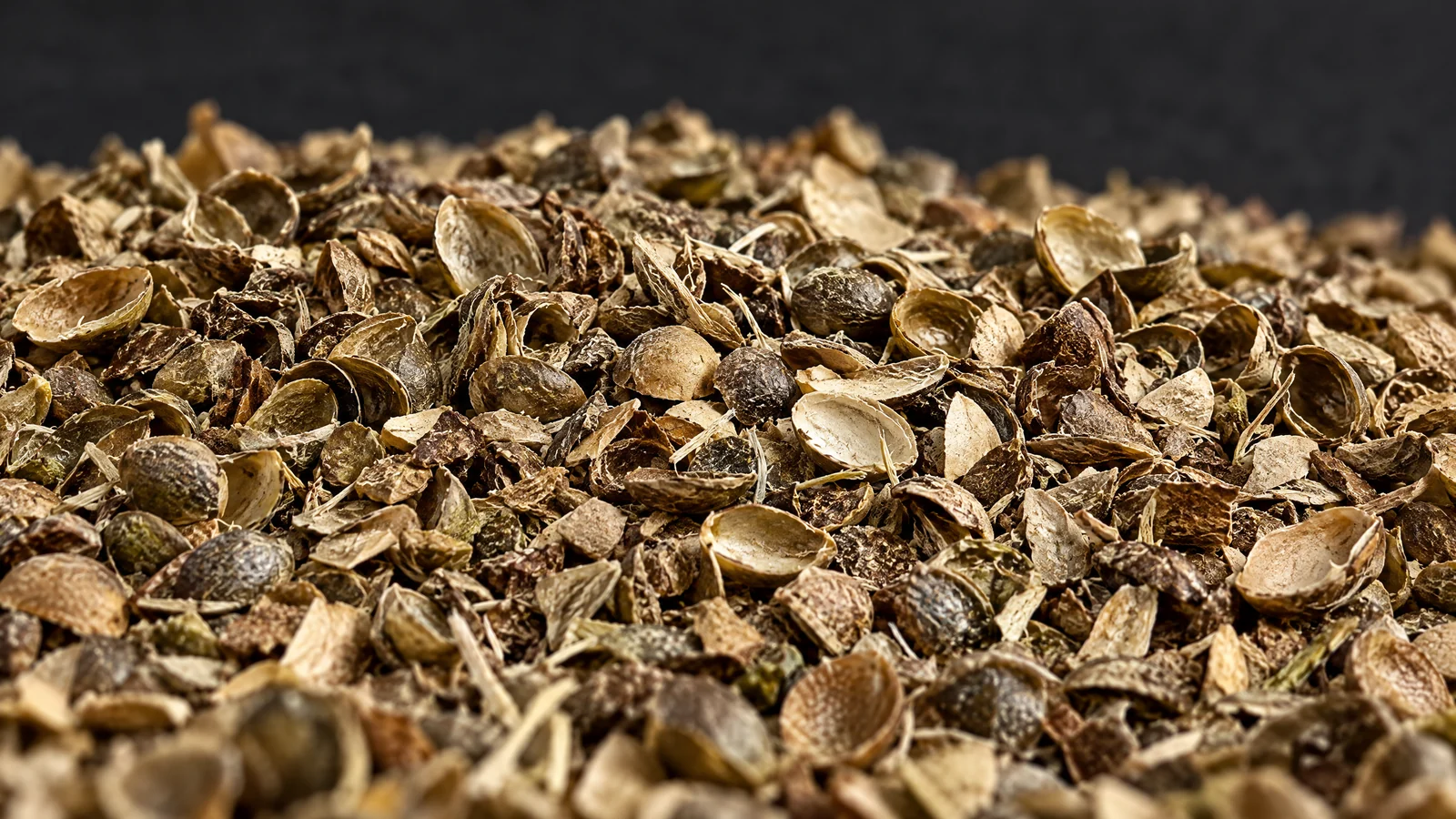
Hempseed shells are the outer coat of the seed, separated during de-hulling. They are primarily a fibre source: published figures put neutral detergent fibre at roughly 65% and crude protein at about 14%, and the lignin fraction is what limits how much of that fibre a rumen can use. A 2026 study in lambs and ewes raised dry matter intake against wheat screenings without depressing weight gain. Shells suit dry cows, growing heifers, ewes, lambs and horses, and fit badly in high-yielding rations. Ours comes off our own dehulling line as a dry flake, and because the fibre fraction varies between runs, the analysis for the specific lot is the only number worth formulating to.
NDF, published figure
crude protein
TDN
optical sorting, our line

- What are hempseed shells?
- How does the shell come off the seed?
- Why does drying temperature matter?
- How do they differ from cake and from the fine fraction?
- What the fibre numbers mean
- Where our shells come from
- Certification behind the material
- Which animals do hempseed shells suit?
- What does the 2026 ruminant study show?
- Bulk handling, dust and storage
- What should you specify before you buy?
- Frequently asked questions
What are hempseed shells?
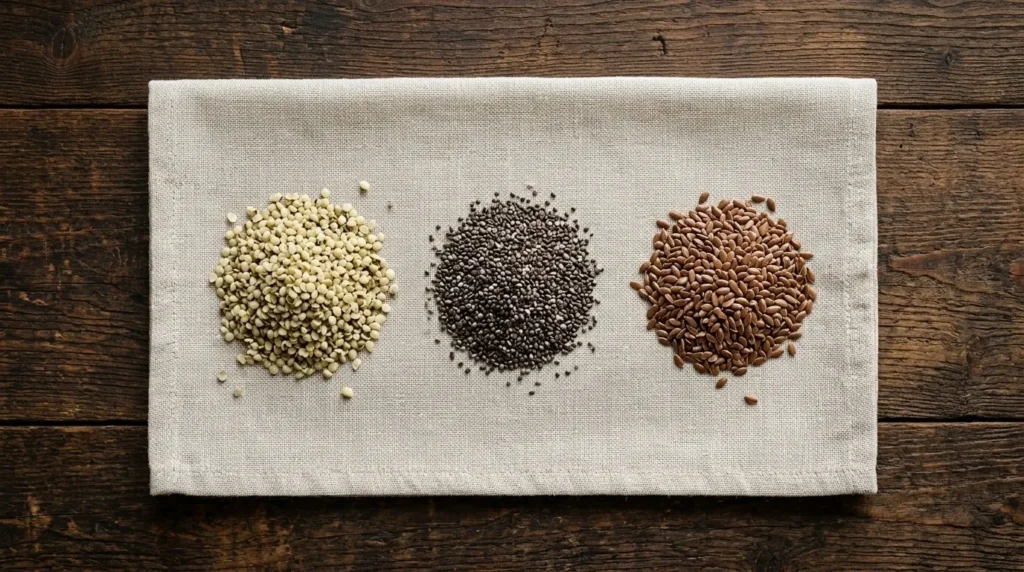
Hempseed has two parts that matter commercially: the kernel, sold as hemp hearts and pressed for oil, and the outer coat, which is thin, pale and slightly woody. To get hearts, the seed is cracked and the coat separated on a de-hulling line, and what comes off is the shell.
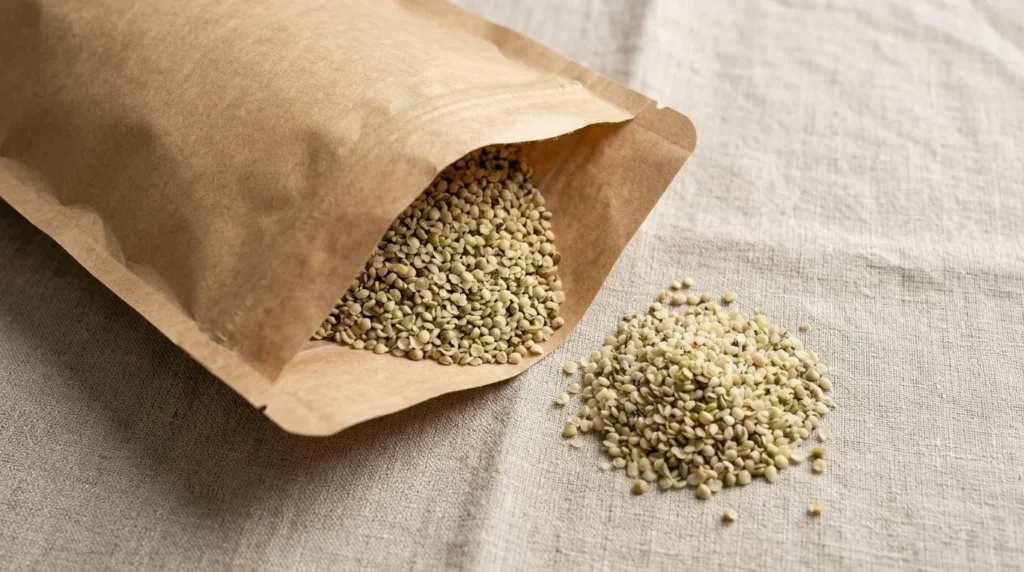
It is not a waste stream in the nutritional sense. The shell is built mostly of structural carbohydrate, which is why it has value where fibre is short and volume matters more than energy density. It leaves the plant as a dry, flowable flake: not milled, not pelleted, not blended with anything else. The share of the seed that leaves as coat moves with the variety, with seed size and with how the lot was dried, so no single ratio holds for all hemp and we report the figure per production run instead of quoting one industry number.
How does the shell come off the seed?
Every lot of seed arrives first at our warehouse in Mustvee, a 3,000 square metre site, and only reaches the processing plant in Vahi, 1,500 square metres, once it has been through intake quality control. Nothing goes onto the dehulling line straight off a trailer.
At intake, each incoming lot runs through a small-scale dehulling trial together with a colour check, so the behaviour of that seed is known before it is committed to the line. Seed size, seed moisture and the way the coat sits on the kernel all change how cleanly the coat lifts away.
On the line the seed is cracked and the coat separated from the kernel. An optical sorter runs at 300 to 600 kilograms per hour and ejects material on colour. It is not a sieve: it removes what a camera reads as dark, discoloured or foreign, not what differs in size. Colour is the first thing a buyer notices in a hull lot, and size grading is a separate question that belongs on the specification.
Raw seed intake runs to 3,000 tonnes a year and the dehulling side to 1,000 tonnes of seed across two shifts. The shell fraction is a direct function of that volume, so tonnage moves with how much seed is dehulled, not how much is bought.
Every tonne of seed that arrives is processed into finished food ingredients, and raw seed is not resold. Shells therefore come off a line that exists to make food, with the sampling, colour control and documentation a food ingredient line carries, rather than out of a waste bin at the back of a feed mill.
Why does drying temperature matter?
The physical quality of a hemp shell is decided in the dryer, weeks before it is bagged, and almost no feed specification captures it. Hemp seed comes off the combine wet enough to spoil, so drying starts immediately. Our dryers are indirect fired, so combustion gas never touches the seed, and the ceiling is 45 to 50 degrees Celsius.
Above 50 degrees the seed coat cracks. A cracked coat lets oxygen reach the kernel underneath, and oxidation begins there, in the store, before the lot has been processed. On the oil side that is the root cause of the rancidity blamed on the press much later. On the shell side it leaves fracture lines through the coat: a more brittle material that breaks into more fragments on the line, with a different dust and flow behaviour from an intact flake.
The dryer exits at 6 to 9 percent seed moisture, targeting 8 percent, which is the moisture the coat carries when it is separated. Polycyclic aromatic hydrocarbons are tested on incoming material, and a lot whose PAH sum exceeds 10 does not go into food use; those samples travel to a laboratory in Germany.
After drying, seed is held in closed bags on pallets, below 15 degrees Celsius and out of the light. Conveyor belts are oil resistant, so a spill does not become a film that oxidises into the next lot.
Two hull lots can show the same NDF and differ completely in brittleness, fines and dust, because one coat was dried within limits and one was not.
How do they differ from cake and from the fine fraction?
| Hempseed shells / hulls | The outer coat on its own, separated during de-hulling. Primarily fibre, and the material this page covers. |
| Hempseed cake / meal | What is left after the oil is pressed out of whole seed. Protein and fibre are both concentrated. |
| Smoothie hemp | The fine fraction from the line: broken kernels plus hull fragments, carrying both materials. |
The three are not interchangeable. Cake is a protein feed, smoothie hemp a protein and fibre feed with a useful fat content, and shells a fibre feed with modest protein and a low energy density, comparable to a medium quality forage.
Smoothie hemp also explains why a brittle coat costs money: it sends more of itself into that fine fraction. Our comparison of smoothie hemp and hempseed cake covers both.
What the fibre numbers mean
Two fibre values circulate for this material and they measure different things. A fibre figure on a food label counts a different set of components from a neutral detergent fibre figure, which counts the whole plant cell wall including the lignin a rumen cannot break down. Both are correct for what they measure, and neither replaces the lot analysis.
| Neutral detergent fibre | Around 65% of dry matter. This places shells alongside soybean hulls rather than beet pulp or bran. |
| Crude protein | About 14%. Not a protein feed, but not negligible either. |
| Total digestible nutrients | About 52%, from a published comparison that used a commercial hemp hull specification, so treat it as indicative rather than as a measured average. The same table puts maize at about 90% and alfalfa hay at about 58%. |
The detail that matters more than any single number is what the fibre is made of. A neutral detergent fibre figure counts the cell wall as a whole; the acid detergent fraction counts the lignified part, and lignin is what a rumen cannot break down. Shells and soybean hulls sit at about 65% and 64% NDF, but soybean hull fibre ferments quickly with very little lignin, which is why it works as an energy-bearing fibre, while hemp shell fibre is more lignified and its published TDN is around 52%.
It is a fibre filler, not a fibre-based energy feed. Formulate it as bulk and structure and it delivers.
For the full comparison with soybean hulls, beet pulp and wheat bran, see our guide to hemp hulls against the other fibre sources.
Product specification for hempseed shells
We report measured values per lot rather than an industry average.
- Neutral detergent fibre, acid detergent fibre and acid detergent lignin per lot from an accredited laboratory, with crude protein, crude fat, ash and moisture in the same panel.
- Bulk density and particle size range, so a mill can plan silo volume and dust control.
- Organic status under EU Organic EE-ÖKO-03, with specification sheet, certificate of analysis and certificate of conformity travelling with the lot.
The current lot analysis is available on request.
Where our shells come from
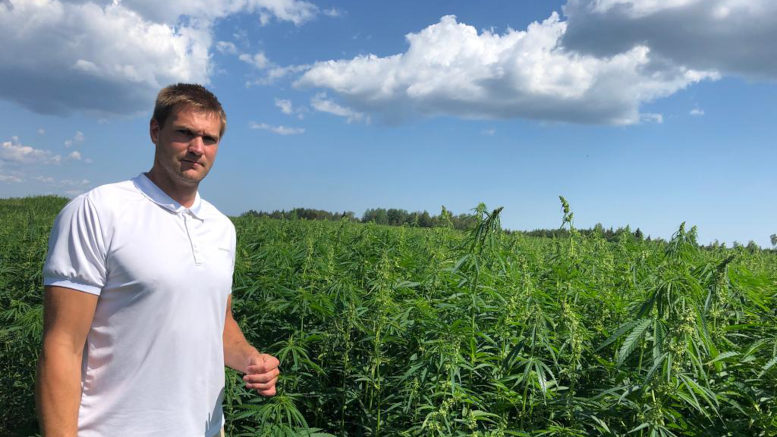
Our hemp is grown under contract on 5,000 hectares in Estonia, on farms we have worked with for years, and processed in our own facility. The seed we dehull is Estica, our own variety. Estica is large-seeded: 95 percent of the seed runs over 3 millimetres and the oil content reaches up to 35 percent, and a larger, more uniform seed cracks more cleanly on a dehulling line.
Nothing in that field programme leans on chemistry. Hemp is grown without herbicides, fungicides and insecticides, and weed suppression comes from sowing density at 120 to 130 seeds per square metre and from the canopy closing over the row.
Certification behind the material
Because the coat arrives from a crop that has not been through a spray programme, the organic claim rests on the field record rather than on paperwork alone. Organic status is certified under EU Organic, registration EE-ÖKO-03, and the site operates to BRCGS, Brand Reputation through Compliance Global Standards. Both are auditable, so the paper trail behind a lot of shells is inspected by someone other than us. We sell business to business, ship worldwide, and our hemp ingredients reach 26 countries.
Which animals do hempseed shells suit?
Fibre is the whole point of this material, so the question is which animals want fibre and can afford the digestibility penalty.
| Dry dairy cows and growing heifers | The natural fit. These animals need rumen fill and structure but are not pushing yield. |
| Ewes and growing lambs | Supported by published trial work. Sheep handle fibrous by-products well and weight gain was not affected. |
| Horses | A logical fit. The hindgut ferments fibre, and a bulky dry material suits maintenance rations and forage extension. |
| High-yielding dairy cows | Not the target. Rumen fill limits intake at high yield, so a low-energy fibre displaces more valuable feed. |
| Pigs and poultry | Very limited. The fibre load and lignin content cap inclusion well below what ruminants tolerate. |
EFSA lists properly processed hemp seed with hulls among hemp seed-derived feed materials, and no maximum inclusion rate is laid down for the material. The limit is therefore nutritional rather than regulatory, and three constraints set it: rumen fill, which arrives first in a high-producing animal; lignin, which caps how much energy is extracted per kilogram; and palatability, because a light flake can be sorted against in a ration that is not mixed thoroughly. Treat shells as a partial replacement for the forage or by-product fibre fraction rather than an addition on top of it, introduce them in the dry-cow or youngstock group first, and watch intake rather than body condition over the first two weeks. In sheep, published work fed hulls at up to roughly a fifth of the diet without depressing weight gain; for cattle no equivalent ceiling exists, which is why a first trial should be small and on your own animals.
What does the 2026 ruminant study show?
A Canadian study evaluated hemp hulls in three parts: in situ rumen degradability of hemp hulls, hemp screenings and wheat screenings using cannulated heifers; growth in feedlot lambs; and lactating ewes.
The headline finding is that dry matter intake rose with hemp hulls compared with wheat screenings, while weight gain was not affected. The animals ate more of the hull-based ration and performed the same, which is what a bulky, slowly fermented fibre diluting the diet would produce.
Two cautions. This is one study, in sheep, and sheep are not dairy cows, so the result should not be read across to a lactating dairy ration without your own trial. It was also run where feeding these fractions to ruminants was not yet a licensed route, which is why the authors framed it as an evaluation rather than a feeding recommendation. It establishes that intake held and weight gain was unaffected; it does not set a maximum inclusion level.
Bulk handling, dust and storage
| Mixing | Shells distribute through a total mixed ration and stay distributed, because the flakes mix into the bulk rather than sinking or floating as a layer. |
| Pelleting | No pelleting step is needed, which saves the heat and cost of a pellet line and preserves the structure that gives the fibre its value. |
| Dust | The trade-off. A dry, light flake releases airborne particles during tipping and mixing, so extraction at the intake pit matters. A stated particle size range is what makes that predictable. |
| Packing and shelf life | 450 to 600 kilogram big bags, with a best before date of 24 months from packing. Bulk tipped loads can be arranged. |
| Storage | Keep cool and dry, out of sunlight, away from walls and off the floor. A lot arriving at 8 percent moisture has far more tolerance than a damp one. |
Bulk density is the number to ask for before you book a silo or a trailer, because a light material fills volume long before it fills weight.
What should you specify before you buy?
Four things decide whether a lot is right for your ration.
- The fibre fractions for that lot. NDF, ADF and acid detergent lignin together, because NDF alone will not tell you how the material will perform.
- Bulk density and particle size range, so you know what it will do in your silo and your mixer.
- The drying regime. Ask at what temperature the seed was dried, because that decides whether the coat is intact or brittle.
- Organic status and certification. If the ration has to carry an organic claim, the certificate has to match the lot.
The documentation should cover all four and arrive before the first trailer does.
Looking for organic hempseed shells in bulk?
Nordic Hemp grows hemp on 5,000 hectares in Estonia and processes it in its own facility, from intake quality control to the dehulling line. We supply organic hempseed shells in bulk for livestock feed, with a certificate of analysis and full documentation per lot. Send us your specification requirements and we will send the lot analysis and shipping details.
Contact us about hempseed shells See the product specificationFrequently asked questions
How are the shells separated from the hemp hearts?
The seed is cracked and the coat separated from the kernel on a dehulling line. Each incoming lot is held at our warehouse in Mustvee for a dehulling trial and a colour check before it moves to the plant in Vahi, where an optical sorter running at 300 to 600 kilograms per hour ejects material on colour.
Does drying temperature affect the quality of hempseed shells?
Yes, and it is the least documented factor in the category. Hemp seed is dried in an indirect fired dryer at no more than 45 to 50 degrees Celsius and exits at 6 to 9 percent moisture. Above 50 degrees the coat cracks, oxygen reaches the kernel and oxidation starts in the store.
Are hempseed shells the same as hempseed cake?
No. Cake is what remains after the oil is pressed out of whole seed, so it is a protein feed with a moderate fibre load. Shells are the outer coat alone: much higher in fibre, much lower in energy, modest in protein.
How much fibre do hempseed shells contain?
Published figures put neutral detergent fibre at around 65% of dry matter, with crude protein at about 14%. The measured values for a specific lot are issued with the certificate of analysis.
Can I feed hempseed shells to dairy cows?
To dry cows and growing heifers, yes. To the high-yielding group, no, because at high yield rumen fill limits intake and a low-energy fibre displaces more valuable feed.
What did the 2026 ruminant study find?
In a Canadian study, hemp hulls increased dry matter intake compared with wheat screenings in growing lambs while weight gain was not affected. It is one study in sheep and should not be read across to dairy rations without your own trial.
What documentation comes with a shipment?
A certificate of analysis for that lot covering NDF, ADF, lignin, protein, fat, ash and moisture, plus bulk density, particle size range and the organic certificate.
Sources
Peer-reviewed and trade sources used for the figures in this article.
- Washington State Department of Agriculture. Report to the Legislature on hemp seed products as feed ingredients for laying hens. Composition summary for whole hemp seed, dehulled seed, hemp seed meal and hemp seed hulls.
- Agricultural Utilization Research Institute (AURI). Energy and crude protein comparison of hemp coproducts with main livestock feedstuffs, total digestible nutrients on a dry matter basis. The hemp hull values in that table are taken from a commercial product specification rather than from an independent feeding trial.
- Evaluation of hemp hulls and screenings as alternative feed ingredients for ruminants (2026). Canadian Journal of Animal Science.
- Incorporation of hemp hulls and screenings as alternative feed sources for ruminants. Journal of Animal Science, abstract 344.
- Feedipedia. Soybean hulls. Composition table, INRA, CIRAD, AFZ and FAO.
- Feedipedia. Beet pulp, dehydrated. Composition table, INRA, CIRAD, AFZ and FAO.
- EFSA Panel on Additives and Products or Substances used in Animal Feed (2011). Scientific opinion on the safety of hemp for use as animal feed. EFSA Journal 9(3): 2011.