Harvesting Hemp with a Combine: Settings, Fibre and Fire Risk
Last updated: October 16, 2026
This is part of our series on growing hemp for seed. The full story of one farmer’s first season is in Growing hemp: the first year.
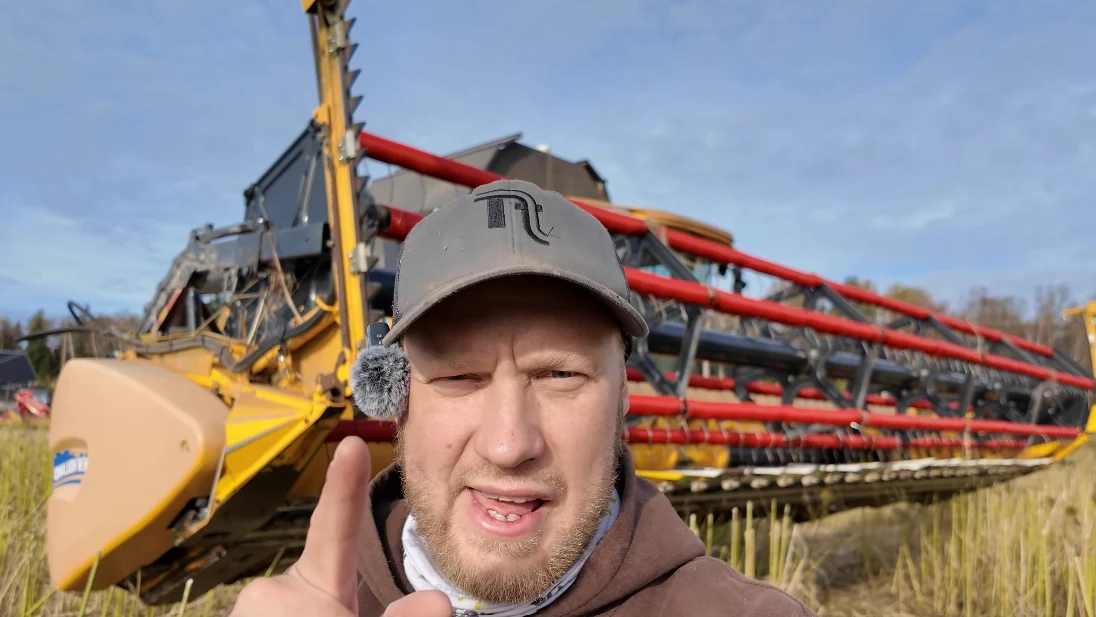
Tõnis Saaval, the farmer behind this 2026 case study, with the combine during the October harvest.
Everyone who has harvested hemp says the same thing: the crop is not the hard part, the combine is. Hemp stalks are fibrous enough to wrap around rotating parts, and once they do, friction builds fast. On one Estonian farm this season, that meant smoke and a small flame on the machine.
This article is the practical part: how the harvest window works, how the machine has to be set up, which parts need protecting, and what to do when fibre wraps anyway.
Harvest hemp with the header as high as possible, taking only the seed-bearing top of the plant, because the fibre in the stalk is what causes wrapping. Guard the exposed shafts, keep the cutter bar sharp, run a low drum speed with a wide concave clearance, switch the straw chopper off, and keep fire equipment on the machine. Hemp harvest runs from late September into October, at roughly a third of the speed of a cereal harvest.
When does hemp harvest start?
The window in Estonia runs from late September into October, and in difficult years into November. Within that window, the daily working time is narrow: heavy autumn dew means the crop cannot be cut until about 1 to 2 in the afternoon, and it has to stop around 8 to 9 in the evening.
It is slow work. Hemp harvests at roughly a third of the speed of a cereal harvest, so a large field takes weeks rather than days. In one documented Estonian case, 800 hectares took about a month with three combines.
The reason for the narrow window is moisture, not yield. Seed that goes into the tank damp is a quality problem before it is a quantity problem, and everything downstream, from drying to storage, depends on when you cut.
Why does the header have to run so high?
Because the fibre is in the stalk, and the fibre is the enemy.
The seed sits at the top of the plant. Everything below that is stalk, and stalk entering the machine becomes fibre wrapped around rotating parts. The practical rule from the field is to cut as high as the machine allows and take only the seed-bearing part.
On a short or damaged crop this is easier. Where a hail-stunted field was harvested this season, the header did not have to run as high and less fibre entered the machine, which made the whole job calmer.
There is one compromise to understand: cutting higher leaves more stalk in the field, which matters if you also plan to use the straw.
Why is fire a real risk on a hemp harvest?
Because friction heats metal quickly once fibre is wrapping.
This season, the exposed 10 to 15 centimetres of the combine’s drive shafts were the problem. Fibre wrapped around them, friction built against the frame, and within minutes there was smoke and a small flame. The fix was simple and cheap: custom sheet-metal guards bolted over the exposed shafts.
After those guards were fitted, the same machine harvested 7 to 8 hectares without a single wrap.
The wrapping, the flame and the guard-plate fix, filmed during the October harvest. The audio is Estonian; subtitles can be auto-translated in the player. Watch on YouTube
Which parts of the combine need protecting?
Based on two seasons of Estonian hemp harvesting experience shared at our grower information days, the list is short and the modifications are ordinary workshop work:
| Area | Protection |
|---|---|
| Exposed drive shafts | Sheet-metal guards over the exposed length, about 10 to 15 cm on this machine |
| Feeder house | Protective plate over the top drive shaft |
| Front axle and gearbox | Bottom plates over the axle, half-shafts and gearbox |
| Hydraulics and wiring | Shielded where they sit near rotating parts |
| Cutter bar | Very sharp section knives, so tough stalks are cut rather than pulled |
| Daily tools | Home-made cleaning hooks for pulling wrapped fibre out from behind bearings |
Choosing the right combine type
Not every machine handles hemp equally well, and the difference is the number of places fibre can wrap itself around. From the experience shared at our grower days:
- Walker combines are the best choice. Fewer rotating parts, gentler material handling, lower repair costs.
- Rotary combines are workable. High output and easy to clean inside, but fibre wraps heavily at the rear of the rotor, near the bearing and gearbox.
- Hybrid combines are not recommended. Too many rotating parts; fibre collects at the ends of the long rotors and cleaning takes a very long time.
What header works best?
A standard auger header tends to trap hemp in the reel tines, and the material arrives at the feeder house in clumps. Where a standard header is used, growers wrap the metal reel tines with plastic tubes to give them a smooth surface, which stops the fibre from catching.
Draper headers work better for hemp: plastic fingers on the reel wrap less, and the belt carries material evenly to the centre. The trade-off is cleaning, because fibre packs tightly around the rollers at the belt edges and the belts have to be opened up.
What settings does hemp need?
Hemp seed releases easily, so high-impact threshing is unnecessary and damages the seed:
- Drum speed: low and gentle, to avoid cracking seed and creating fibre dust
- Concave clearance: as wide as the machine allows
- Straw chopper: off. Hemp fibre will wrap around the chopper rotor and destroy it
- Fan speed: start low, as for rapeseed, because hemp seed is light
How fast does a hemp harvest actually go?
After the settings were corrected, this machine ran at 5 to 6 tonnes per hour and delivered a yield of about 1 tonne per hectare of clean, dry seed.
Two numbers are worth keeping in mind while planning. First, hemp harvest is slow relative to cereals, so the season is long. Second, threshing 1,000 hectares of wheat produces roughly 6,000 tonnes of wet grain and about 240 truckloads to move; the same area of hemp produces around 1,000 tonnes, or about 40 truckloads. The lower volume is easier on drying capacity and transport, even though the harvest itself takes longer.
What happens to the stalks after harvest
They stay on the field. The stalks are left in windrows through the winter, where snow and moisture soften them in a natural retting process that separates the fibre from the woody core. In spring the material is raked and baled, and it becomes raw material for construction products and biocomposites.
If you plan to sell the straw as well as the seed, cut higher rather than lower. Cutting low puts fibre in the machine and takes value out of the field.
What should you check before you start the engine?
- Clean all combines and transport vehicles of the previous crop first. Contamination of a food-grade crop starts in the machine, not the field.
- Fit guards before the first hectare, not after the first fire.
- Put fire equipment on the machine and keep it there.
- Agree with your buyer what seed moisture and cleanliness they expect, so the harvester settings match the specification.
- Plan the drying before the harvest, not during it.
Growing hemp for seed?
Talk to us about varieties, agronomy and buying terms before the season starts.
Frequently asked questions
Is harvesting hemp hard?
The harvesting is harder than the growing. Hemp fibre wraps around rotating parts, which means the combine needs guards, the right header, high cutting and corrected settings. Plan for it before the season, not during it.
Why do hemp combines catch fire?
Fibre winds around exposed shafts and pulleys, and the friction generates heat, smoke and flame. Guarding the exposed shafts and cutting higher to reduce fibre intake are the two fixes that worked on this farm.
Can you harvest hemp with a standard combine?
Yes, with modifications: guards on the exposed shafts and feeder house, sharp section knives, plastic sleeves over the reel tines where a standard header is used, and the straw chopper disengaged.
Which combine type is best for hemp?
Walker combines are preferred because they have fewer rotating parts where fibre can wrap. Rotary machines work but need more cleaning. Hybrid combines are not recommended for hemp.
How fast can you harvest hemp?
Roughly a third of the speed of a cereal harvest. After the machine was set up correctly, this season’s harvest ran at 5 to 6 tonnes per hour with a yield of about 1 tonne per hectare.
What moisture should hemp seed be at harvest?
Seed should be dried immediately after harvest and stored at 6 to 9% moisture. Leaving damp seed in a trailer overnight is enough to start mould and bacterial growth.

Sources and further reading
- Farmer Tõnis, hemp growing series in cooperation with Nordic Hemp: youtube.com/@farmertonis (episode 8 covers the harvest)
- Nordic Hemp, hemp cultivation information days for growers: youtube.com/@nordichempcooperation
- Canadian Hemp Trade Alliance, combine troubleshooting for hemp: hemptrade.ca