Smoothie Hemp or Hempseed Cake? A Guide for Feed Formulators
Last updated: October 27, 2026
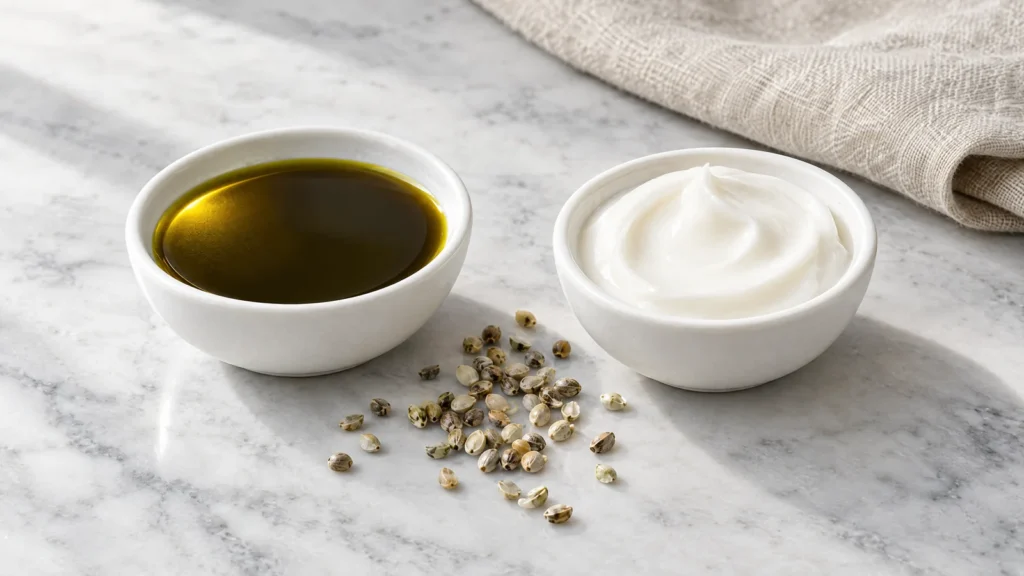
Nordic Hemp produces both of these feed materials from the same processing line, and both end up in a feed ration. Smoothie hemp is available now for livestock feed. That is where the similarity stops. Hempseed cake is what remains when the oil is pressed out of the seed. Smoothie hemp is the fine fraction left over when the seed is de-hulled to make hemp hearts. One is a protein feed. The other is a protein and fibre feed with a particle size that behaves very differently in a mixer. Choosing between them is a question about your ration, not about which product is better.
This guide compares the two on composition, on what the feeding trials actually measured, and on the practical questions a feed formulator asks: how much can I include, what does it do to the mix, and what do I need on the specification before I commit.
Choose hempseed cake when the ration needs a protein concentrate and the line can handle a meal. It is the pressed residue, so the oil has gone and the protein is concentrated. Choose smoothie hemp when the ration can take more fibre and you want a granular fraction that blends into a total mixed ration without segregating and without a pelleting step. In the published trials, dehulled hemp meal replaced 15% of dietary dry matter in place of canola meal in lactating dairy cows with no change in dry matter intake, milk yield, milk protein or milk fat. In growing pigs the ceiling was lower, at about 10% of the diet with lysine balanced. Neither product is a drop-in for the other, because the fibre load and the handling behaviour are different.
crude protein
NDF
no pelleting needed

Where the two products come from
The difference starts at the press and the de-huller, which are two different steps in the same plant.
Hempseed cake is the material left after the oil has been expelled from whole seed. The seed goes in, the oil comes out, and what remains is pressed into cake or milled into meal. Because the fat has been removed, everything else in the seed is concentrated, so protein and fibre both rise relative to the whole seed.
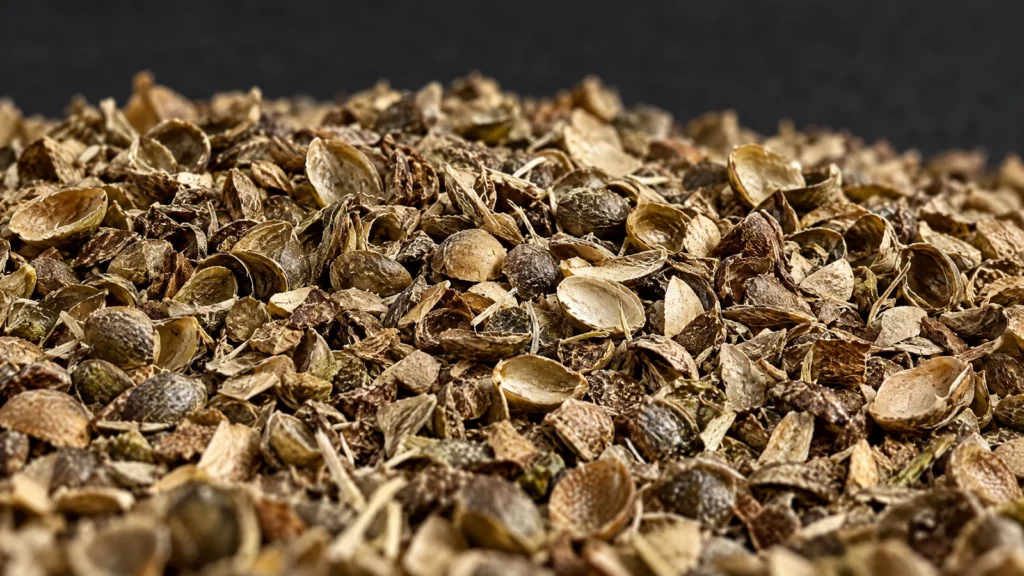
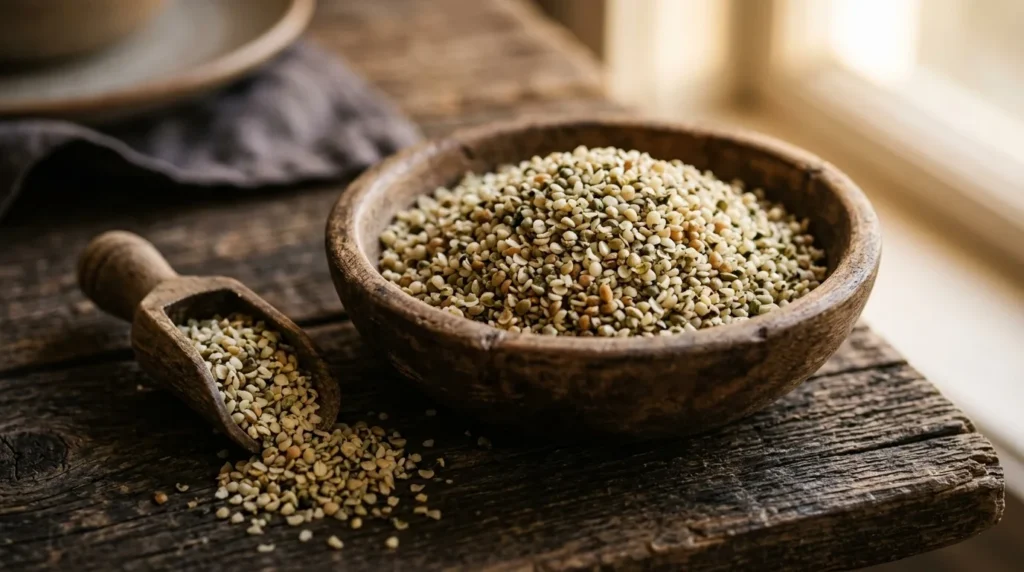
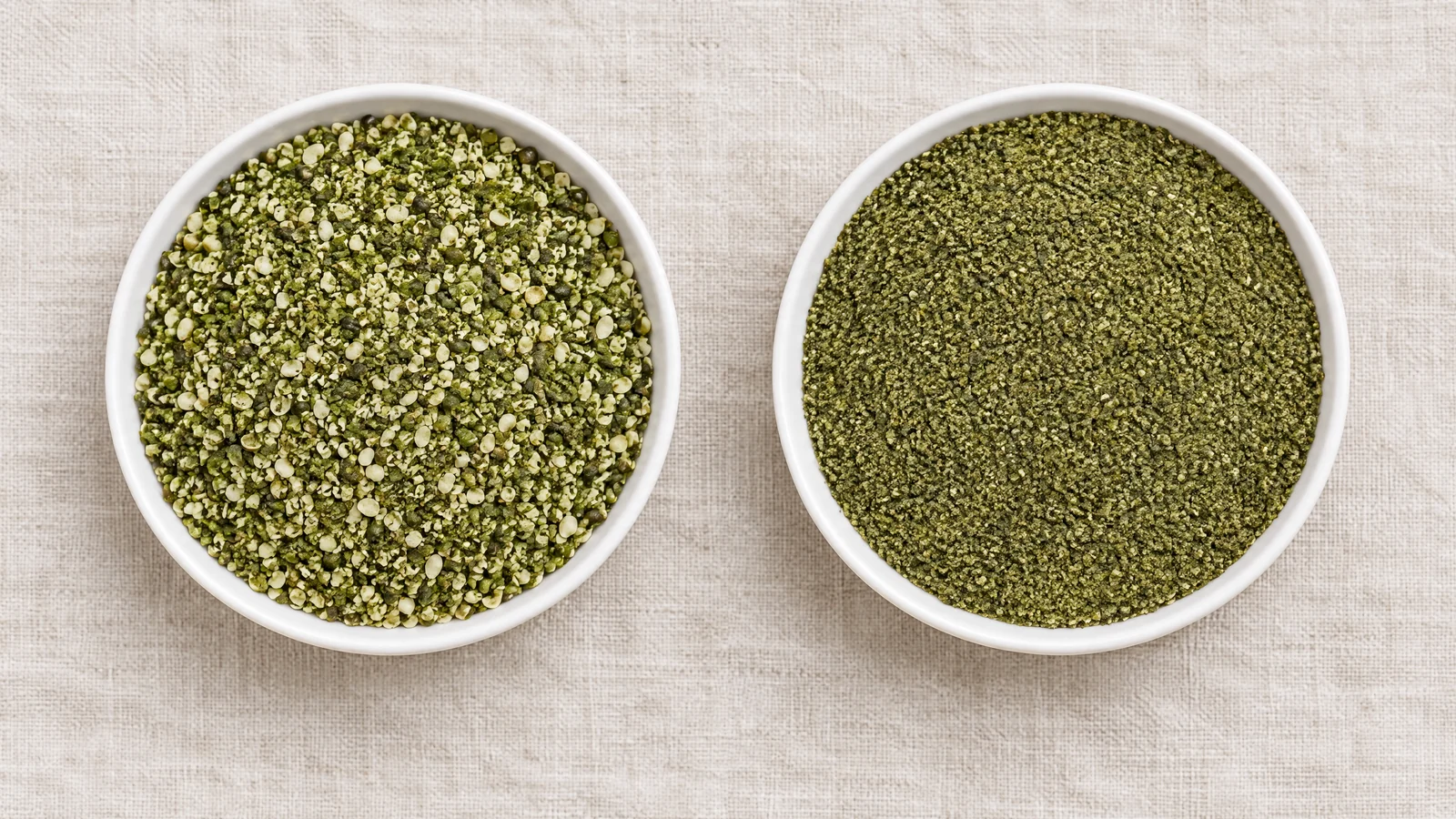
Smoothie hemp is the fraction that falls out of the de-hulling line. When seed is cracked and the hulls are separated to produce hemp hearts, some kernels break and some hulls split into fragments. That mixture is collected as a fine granular fraction. No oil is removed, so the fat content stays closer to the whole seed, and the hull fragments raise the fibre.
Put simply: cake is a protein feed with the oil taken out. Smoothie hemp is a protein and fibre feed with the oil still largely in it.
How hempseed cake and smoothie hemp compare
The published figures for the products around them show where each one sits.
| Hempseed cake / meal | Typically 28 to 32% crude protein, 9 to 10% oil and 32 to 40% neutral detergent fibre. The standard protein feed in the hemp category. |
| Smoothie hemp | Between the meal and the hull figures. Kernel fragments bring protein and fat, hull fragments bring fibre. The ratio depends on the production run. |
| Hempseed hulls | The outer coat on its own. Little protein, a high fibre load. A fibre source rather than a protein source. |
| Whole hempseed | 20 to 25% crude protein, 30 to 35% oil and 30 to 35% NDF. Balanced, but has to be processed or rolled before most animals use it efficiently. |
The practical consequence is that cake carries the higher protein density per tonne, while smoothie hemp carries more fat and more fibre and arrives in a form that disperses through a mix.
A note on energy. Because smoothie hemp retains more of the seed oil than cake does, its energy contribution per kilogram is not the same. If your formulation balances on energy and not only on protein, ask for the fat figure on the lot analysis and treat it as a formulation input rather than an afterthought.
The number that decides it
Analysis matters more than the category here. Smoothie hemp carries more hull than meal does, so expect a lower protein figure and a higher fibre figure than the meal row in the table above. Both products are issued with a per-lot analysis, and that analysis is the only figure worth formulating to.
The full parameter set, including the microbiological and regulated-parameter panel, comes with the lot analysis on request. Our guide to smoothie hemp as livestock feed covers the parameters in full, and the checklist below covers what to ask for.
Which fits a dairy or beef ration?
This is where the evidence is strongest, and it is evidence for the meal side of the comparison. A controlled trial at a Canadian university replaced canola meal with dehulled hemp meal in the diets of twelve lactating Holstein cows, at 15% of dietary dry matter. Three isoenergetic and isonitrogenous rations were compared: canola meal only, hemp meal only, and a 50/50 split.
| Dry matter intake | No difference between diets |
| Milk yield | No difference |
| Milk protein | No difference |
| Milk fat | No difference |
| Total-tract fibre digestibility | No difference |
Hemp material took the place of canola meal at 15% of dry matter and the cows performed identically. The trial also found that apparent total-tract dry matter digestibility was lowest on the all-hemp ration, which tells you the practical working level is around 15% rather than at 30%.
For a dairy ration specifically, the split is straightforward. Cake is the protein component and slots into the concentrate portion. Smoothie hemp adds both protein and fibre, so it can take part of the forage side of the balance rather than only the concentrate side. Where a ration is already long on fibre, cake is the easier fit. Where a ration needs bulk and fibre and the forage is expensive, smoothie hemp carries more of the load.
For beef cattle the direct evidence is thinner, and it is worth saying so. Hempseed cake has been fed to growing and finishing cattle in published work, where the higher fibre content raised neutral detergent fibre intake compared with a soya-based supplement while dry matter intake stayed comparable. Treat that as supporting evidence rather than as a recommendation at a specific inclusion rate.
Which fits pigs and poultry?
Pigs are the species where the choice between the two matters most, because fibre is the limiting factor and the two products differ on exactly that.
Digestibility itself is not the problem with hemp material. In a study comparing hempseed meal with linseed meal and canola meal in growing pigs at 25 to 30% inclusion, apparent ileal crude protein digestibility was essentially identical between hemp and linseed, at 86.5 and 86.7%. Standardised ileal digestibility of several essential amino acids was higher for hemp than for linseed, and mostly higher than for canola meal. Crude fat digestibility was clearly better on hemp than on linseed, at 91.9 against 84.7%.
The limit shows up in growth performance. A pilot study with 60 kg growing pigs found that 10% hempseed meal could partially replace soybean meal when the ration was formulated to meet the standardised ileal digestible lysine requirement. At 15%, growth fell.
That is the argument for cake in pig diets: you get the protein with the lower fibre load, so you can include more of it before performance suffers. Smoothie hemp, carrying more hull material, reaches the fibre ceiling sooner. In a growing pig ration, cake is the safer starting point.
| Growing pigs | Cake. Around 10% of the diet as a partial soya replacement, with lysine balanced. Above that, growth suffers. |
| Gestating sows | Smoothie hemp is the more interesting of the two here. Dietary fibre in sow gestation diets is well recognised for improving satiety, reducing stereotyped behaviour and supporting gut health, which is exactly what a fibre-rich fraction brings. |
| Poultry | Cake, at the published maximums of 3% for fattening birds and 5 to 7% for laying hens. Poultry is the tightest of the species covered here. |
Which fits a horse ration?
Horses handle hemp material better than any other species tested, and the reason is the fibre. The horse hindgut is built for fermenting fibre, so a high-fibre fraction is a natural fit rather than a constraint. That makes smoothie hemp a good match on paper.
The published evidence, though, is on the meal side. The only dedicated palatability study found that horses clearly preferred hempseed meal pellets over soybean meal and over sugar beet pulp, with palatability comparable to rice bran. They also increased their intake over time without reducing hay consumption.
A pilot study then pushed the inclusion rate much further. Diets contained 0, 10, 20 or 40% hempseed meal, fed alongside grass hay. No refusals occurred at any level, including 40%. Total-tract protein digestibility, hay intake and faecal scores were unaffected.
Two caveats belong in the same paragraph. That pilot used a small number of horses, and the lignin content of the material was 14.4%, which is high compared with grains and soybean meal. The finding establishes acceptability and short-term safety at 40%, not a long-term recommendation at 40%.
For a horse ration the case for cake is the published evidence. The case for smoothie hemp is the fibre fit and the handling, and it should be introduced on the strength of its own analysis rather than by assuming the cake findings transfer.
Which one is easier in a feed mill?
This is the section where smoothie hemp wins outright, and it is not about nutrition. Two differences decide it: how each product behaves in the mixer, and whether the line has to pellet.
| Mixing behaviour | Smoothie hemp distributes evenly through a total mixed ration and stays distributed. Whole seed segregates and rises to the surface, so some animals get more than others. Cake sits in between. |
| Pelleting | Smoothie hemp needs no pelleting step. Cake is normally pelleted or crumbled as part of the concentrate line, which adds cost and heat. |
Dust and storage are the trade-offs on the smoothie hemp side, and both are covered in detail in our guide to smoothie hemp as livestock feed.
What should you specify before you buy?
Three things decide whether a lot is right for your ration, whichever of the two products you are buying.
- The analysis for that lot, not a generic table. Protein, fat, NDF, ADF, ash and moisture. The kernel to hull ratio varies between runs of smoothie hemp, and the residual oil varies between cake lots.
- Particle size range, for smoothie hemp. So you know what the material will do in your intake, mixer and augers.
- Organic status and certification. If your ration has to carry an organic claim, the certificate has to match the lot.
Need to compare both products for your ration?
Nordic Hemp grows hemp on over 5,000 hectares in Estonia and processes it in its own facility. We supply hempseed cake and smoothie hemp in bulk for feed use, with a certificate of analysis and full documentation for each. As of October 2026, 55 tonnes of smoothie hemp are available for feed. Send us your ration requirements and we will tell you which of the two fits better.
Ask us about cake and smoothie hempFrequently asked questions
Is smoothie hemp the same as hempseed cake?
No. Hempseed cake is what remains after the oil is pressed out of the seed, so protein and fibre are concentrated and fat is low. Smoothie hemp is the fine fraction from de-hulling, so it retains more of the seed oil and carries more hull material. One is a protein feed, the other a protein and fibre feed.
Which has more protein, cake or smoothie hemp?
Cake, per tonne. Hempseed meal typically carries 28 to 32% crude protein, and that density comes from the oil having been removed. Smoothie hemp sits between the meal and hull figures, because part of what it contains is hull. Ask for the lot analysis rather than relying on a general figure.
Which one should I use for dairy cows?
Cake is the direct substitute for canola meal in the concentrate portion, and that is what the dairy trial tested: dehulled hemp meal at 15% of dietary dry matter with no change in intake, milk yield, milk protein or milk fat. Smoothie hemp adds fibre as well as protein, so it can take part of the forage side of the balance instead.
Which is better for growing pigs?
Cake. Around 10% of the diet as a partial soya replacement, with the lysine requirement met. At 15%, growth performance fell in a pilot study because of the fibre load. Smoothie hemp carries more hull material, so it reaches that fibre ceiling sooner.
Why would I choose smoothie hemp instead of cake?
Three reasons. It blends into a total mixed ration without segregating. It needs no pelleting step. And it brings fibre as well as protein, which suits gestating sows and rations where forage is expensive. The trade-off is more dust at the intake and a lower protein density per tonne than cake.
Can I feed either product to horses?
Horses accept hemp material well, and the published evidence sits on the meal side: no refusals up to 40% of the concentrate, with no effect on protein digestibility, hay intake or faecal scores in a short pilot. Smoothie hemp should be introduced on the strength of its own analysis rather than by assuming those findings transfer.
Do both products need the same documentation?
Yes. A certificate of analysis for that specific lot covering protein, fat, fibre, ash and moisture, plus the particle size range for smoothie hemp and the organic certificate if an organic claim is needed. Ask for the complete specification for your market before you commit to a volume.
Where can I read more about smoothie hemp on its own?
We cover it in full in our guide to smoothie hemp as livestock feed, which goes through the product definition, the species by species inclusion levels and the handling behaviour in more detail than this comparison.
Sources
Peer-reviewed and trade sources used for the figures in this article.
- Addo F, Gervais R, Ominski K, Yang C, Plaizier JC (2023). Comparing dehulled hemp meal and canola meal as a protein supplement for lactating dairy cows. Journal of Dairy Science 106: 8670 to 8683.
- Trottier NL, Yeager CE. Harnessing hemp: evaluating nutritional value and application in equine and swine diets. Department of Animal Science, Cornell University.
- Presto MH, Lyberg K, Lindberg JE (2011). Digestibility of amino acids in organically cultivated white-flowering faba bean and cake from cold-pressed rapeseed, linseed and hemp seed in growing pigs. Archives of Animal Nutrition 65: 21 to 33.
- Federation of International Hemp Organizations (2024). Hemp in livestock feed: global review and consensus document on feed compositional considerations for hempseed byproducts.
- Evaluation of hemp hulls and screenings as alternative feed ingredients for ruminants (2026). Canadian Journal of Animal Science.
- EFSA Panel on Additives and Products or Substances used in Animal Feed (2011). Scientific opinion on the safety of hemp for use as animal feed. EFSA Journal 9(3): 2011.