Smoothie Hemp Available for Livestock Feed: Contact for Shipping details and rates
Last updated: October 28, 2026
An impact dehuller throws whole hemp seed against a wall so the coat splits away. Three streams come off that line: the hull, the dehulled seed, and a green particle that sits between them. That green particle is smoothie hemp, and Nordic Hemp sells it in bulk as it comes off the line, without further processing. Its accredited analysis reads 30.3% protein and 38.4% fat, which places it far closer to the kernel than to any fibre by-product.
This article sets out what the material is, what the analysis measures, where the fat content sets the practical limit, how a powder of this kind stores and handles, and what belongs on the specification before a load is booked. It does not quote an inclusion rate, because no feeding trial on this material has been published.
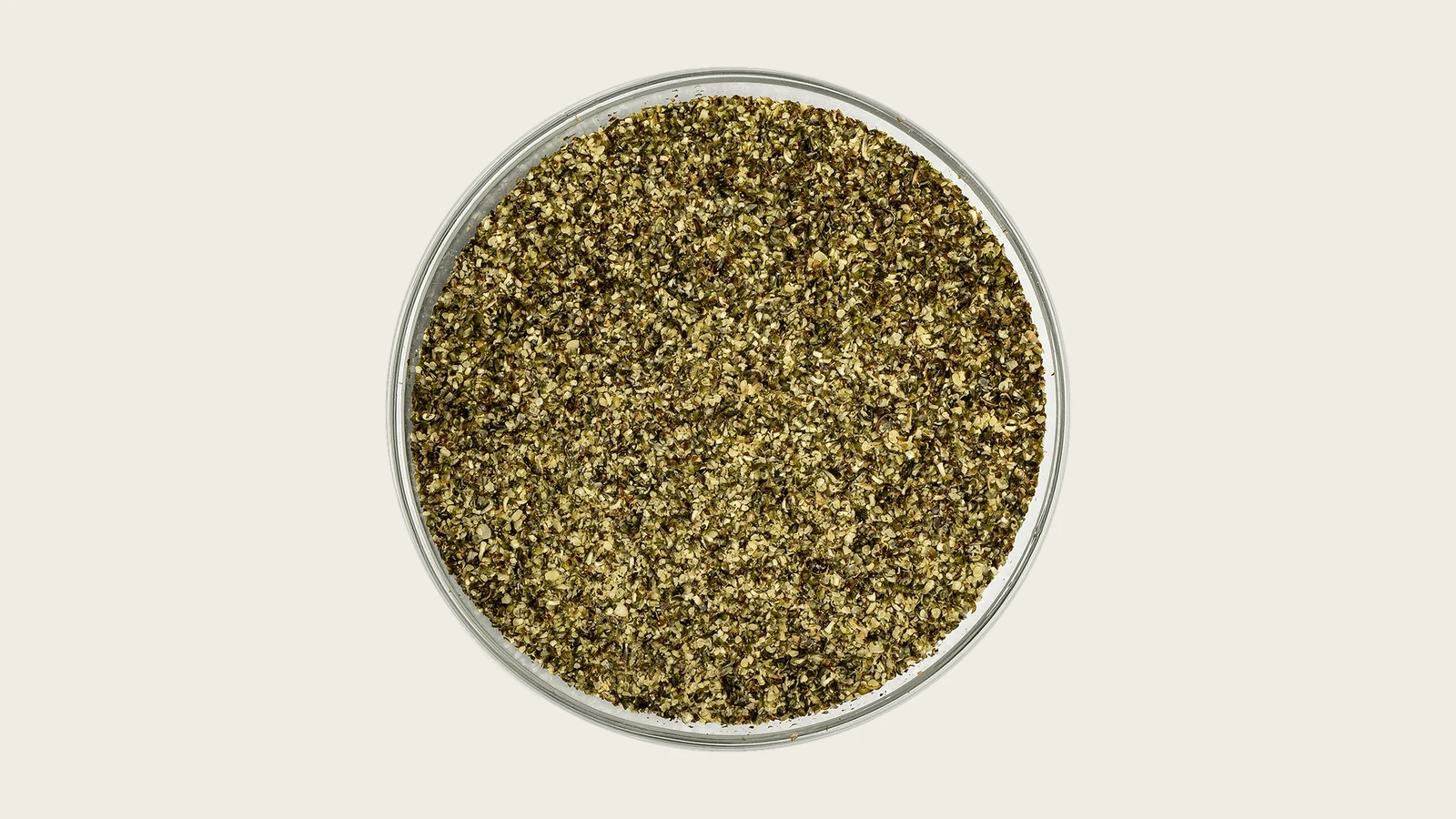
Smoothie hemp is the green particle left over from impact dehulling: kernel material with a little hull and very small fragments of dehulled seed. Our accredited analysis measures 30.3% protein, 38.4% fat and 17.0% fibre, so it acts as a protein and energy material rather than a fibre source. It ships as a powder with no further processing. Because fat accounts for more than a third of the material, the practical limit on inclusion is the fat ceiling of the ration rather than its fibre load.
measured, g/100 g
measured, g/100 g
measured, g/100 g

What smoothie hemp actually is
Hemp seed is dehulled mechanically, and the machine used for it is not gentle. An impact dehuller accelerates the seed and throws it against a steel surface. The coat cracks and separates, and the kernel is left intact enough to be sold as hemp hearts.
What comes off that line is not two clean streams but three. There is the coat. There is the dehulled seed. And there is a green particle that is mostly kernel, carrying a small amount of coat and very small pieces of dehulled seed. That third stream is smoothie hemp.
This matters for anyone who has read about hemp by-products, because most published work describes the pressed cake, the meal and the hulls. Smoothie hemp is none of those. It is kernel material that has not been pressed and has not had its oil removed, which is why the fat figure is high rather than at the level of a pressed meal.
In normal operation this stream goes on to protein and oil production. What we are offering now is the material exactly as it leaves the line, unprocessed, because it is already in the warehouse and there is no plan to run it further.
Why does the particle come out green?
Hemp kernels are green. The chlorophyll sits in the kernel itself, not in the coat, so any fraction that is mostly kernel reads green, and the more kernel a fraction holds, the more green it looks.
The coat looks pale and woody, the kernel looks green, so the colour of a sample is a rough guide to which part of the seed you are looking at. The two have completely different compositions, and the colour difference is not cosmetic.
Our material leaves the separation step as a powder and is sold in that form. It is not granular and it is not pelleted.
What the accredited analysis measures
The figures below come from our own accredited analysis, carried out by GBA Gesellschaft für Bioanalytik in Hameln, Germany, on a sample received in June 2025. They are measured values for this material, not industry averages.
| Protein | 30.3 g per 100 g, calculated as nitrogen multiplied by 6.25. |
| Fat | 38.4 g per 100 g, of which 30.0 g is polyunsaturated, 4.4 g saturated and 4.1 g monounsaturated. |
| Fibre | 17.0 g per 100 g. |
| Carbohydrate | 3.5 g per 100 g, all of it sugars. |
| Ash and moisture | 5.6 g and 5.9 g per 100 g. |
| Energy | 2131 kJ, or 515 kcal, per 100 g. |
| Sodium | Below 0.001 g per 100 g, so salt is effectively absent. |
Two of those figures decide how the material behaves in a ration: protein at 30.3% and fat at 38.4%. The fibre figure of 17.0% comes from food analysis and cannot be set against a neutral detergent fibre value from a feed assay, because the two count different things.
So the common assumption that a de-hulling by-product is a fibre ingredient does not hold for this one. Smoothie hemp is the opposite case: high fat, high protein, moderate fibre.
Does the fat content limit inclusion?
Yes, and it is the first thing to work out before the material goes into any ration.
Rumen function depends on the fibre-digesting population, and that population is sensitive to fat. When fat in a ration climbs, fibre digestion slows, and the ceiling arrives earlier than most people expect. A material at 38.4% fat therefore cannot be treated like a protein meal that happens to be a little oily. It has to be counted against the fat the ration already carries from other ingredients before any of it is added.
That gives a practical rule. Work out the headroom in the ration’s fat budget first, then see what share of it smoothie hemp can take. In a ration that is already carrying protected fat or oilseed, the headroom may be small. In a dry cow or growing ration with little added fat, it may be larger.
We do not publish a recommended inclusion rate, and the reason is not caution for its own sake. No feeding trial on this specific material has been published, so any number we printed would be a guess dressed up as guidance. What we can do is publish the analysis, and let a formulator place it against the ration they are actually building.
Which rations suit a protein and fat powder?
The profile points away from high-yielding dairy, where the fat budget is usually already spent and rumen stability matters most. It points towards rations where energy density is welcome and the fat headroom is open.
| Growing and finishing animals | Energy density is the point of the ration, so a high-fat material has somewhere to go. |
| Dry cows and growing heifers | Useful where the ration is not already carrying added fat and the aim is condition rather than peak output. |
| Poultry | High-energy raw materials are normal in poultry diets, though the powder form needs to fit the mixing line. |
| High-yielding dairy | The hardest fit. Fat headroom is usually thin and rumen function is the priority. |
| Pigs | Workable in principle for energy, but a high-fat powder changes the handling and the pellet quality of the mix. |
Those are profile judgements from the analysis, not trial results. Treat them as a starting point for your own evaluation rather than as a recommendation.
How does a powder store and handle?
A powder at 38.4% fat behaves differently from a dry meal, and most of the difference is in storage rather than in mixing.
| Oxidation | Fat at this level is the storage risk. Cool, dry and dark slows it, and the material should be kept away from light and away from walls. |
| Caking | Fine powders compact under their own weight in a silo. Deep silos and long residence times make it worse. |
| Dust | A fine powder generates airborne particles at the intake. Extraction at the pit is not optional. |
| Mixing | It disperses through a mix quickly because the particle is small. That is the advantage of the powder form. |
| Pelleting | High fat reduces pellet durability, so a mill running a pellet line should test before committing a large volume. |
The material is packed in 30 plastic bags of 20 kilograms in a transport box, 600 kilograms in total, or in a big bag. Shelf life is 24 months from packing when it is stored cool and dry.
What should you specify before you buy?
Four things decide whether a lot is right for your ration.
- The analysis for that lot, not the average. Protein, fat, fibre, ash and moisture, plus the fatty acid split. Fat is the number that governs the application, so it is the one to check first.
- Particle size and bulk density. A powder fills a silo by weight in a very different way from a meal, and dust control depends on knowing the fineness.
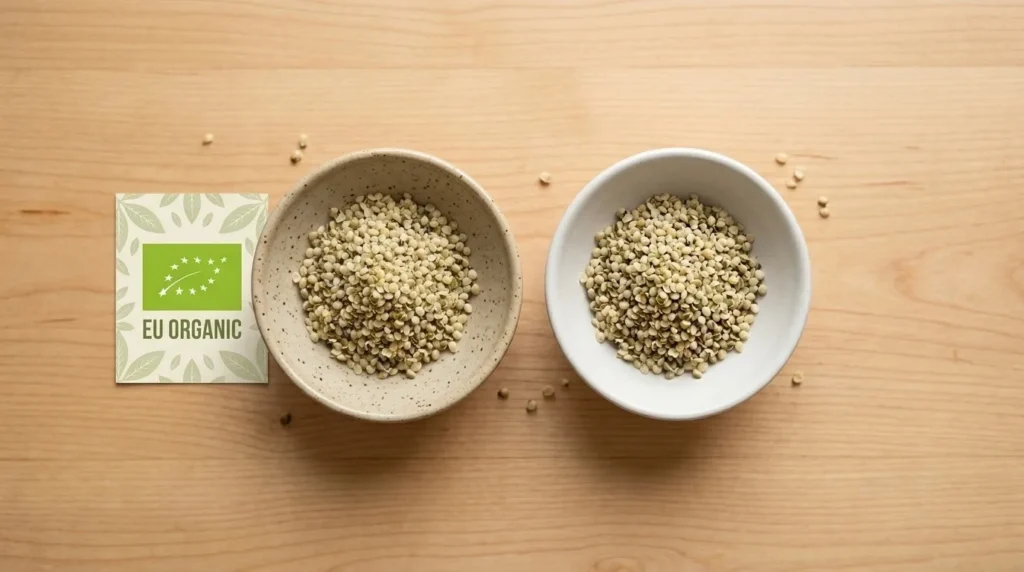
- Organic status and certification. The material is certified organic, and the certificate has to match the lot if your product carries an organic claim.
- Storage and packing format. Bags or big bag, and how long the lot has already been in store, because fat at 38.4% does not improve with age.
Looking for smoothie hemp in bulk?
Nordic Hemp grows hemp on 5,000 hectares in Estonia and processes it in its own facility, selling business to business and shipping to 36 countries. We supply smoothie hemp as it comes off the line, with the accredited analysis for each lot. Send us your requirements and we will send the current analysis.
Contact us about smoothie hemp See the product specificationFrequently asked questions
What is smoothie hemp exactly?
The green particle left over from impact dehulling: mostly kernel, with a little hull and very small fragments of dehulled seed. It is the stream that would otherwise go on to protein and oil production, sold here as it comes off the line.
Is smoothie hemp a fibre product?
No. Our accredited analysis measures 17.0% fibre, against 38.4% fat and 30.3% protein. It behaves as a protein and energy material. The hull is the fibre product from the same line.
Why is the fat content so high?
Because the particle is kernel material and the oil has not been pressed out of it. Fat sits close to whole seed levels rather than at the level of a pressed meal.
Can it be fed to dairy cows?
It can be used, but dairy is the hardest fit, because the fat budget in a dairy ration is usually already committed. Count it against the fat the ration already carries before adding any.
Why is there no recommended inclusion rate?
Because no feeding trial on this material has been published. Any rate we printed would be a guess. We publish the analysis instead, so the figure can be placed against the ration you are actually building.
How is it packed and how long does it keep?
In 30 bags of 20 kilograms in a transport box, 600 kilograms in total, or in a big bag. Best before is 24 months from packing, stored cool, dry, away from light and away from walls.
Why is it green?
The chlorophyll is in the kernel, not the coat. A green fraction is mostly kernel, which is exactly what this material is. A pale tan material would tell you it is mostly hull.
Sources
Sources used for the figures in this article.
- GBA Gesellschaft für Bioanalytik mbH, Hameln. Certificate of analysis 25308690-001, sample Smoothie 2.0 (organic), analysis completed 13 June 2025. Protein 30.3 g, fat 38.4 g, fibre 17.0 g, ash 5.6 g, moisture 5.9 g per 100 g.
- Nordic Hemp product specification, smoothie hemp. Packing, storage conditions, shelf life and variety.