Hemp Seed Oil for Skincare Manufacturers: A Formulation Guide (2026)
Last updated: October 5, 2026
Hemp seed oil has moved from niche to shelf. It now shows up in facial serums, body lotions, hand creams, cleansers and hair products from brands all over Europe, and formulators keep coming back to it for three reasons: the fatty acid profile, the light skin feel, and the story behind the ingredient.
If your product development team is evaluating hemp seed oil, this guide covers what’s actually in the oil, how it behaves in a formula, which product categories it suits, and what to specify when you buy it. Nordic Hemp cold-presses hemp seed oil in Estonia from hemp grown on our own fields, and we supply cosmetic manufacturers worldwide.
Hemp seed oil is a cold-pressed fixed oil used as a carrier or base oil in skincare. CosIng, the European Commission’s ingredient database, lists it as a skin conditioning emollient. It is high in linoleic acid (omega-6) with alpha-linolenic acid (omega-3) at roughly a 3:1 ratio, plus gamma-linolenic acid (GLA), vitamin E and phytosterols. It is a light, fast-absorbing oil, non-comedogenic, and suits dry, sensitive, mature and blemish-prone skin. Source it cold-pressed and unrefined if you want the full fatty acid profile, and ask your supplier for the specification, the analysis and the organic certificate.

What is hemp seed oil?
Hemp seed oil is a fixed oil pressed from hemp seeds. It is not an essential oil and it is not an extract of the flowers or leaves. The oil comes only from the seed, which is why its composition is built around fatty acids rather than aromatic compounds or resins.
Cold pressing keeps the oil close to its natural state. The seeds are pressed at low temperature without solvents, so the tocopherols, phytosterols and the full fatty acid profile stay in the oil. Refined hemp seed oil is lighter in colour and more neutral in scent, but it also loses part of what makes the ingredient interesting in a skincare formula.
For a formulator, that difference is the first decision you make: unrefined and characterful, or refined and neutral. Both exist, and both are legitimate depending on the product you are building.
How is hemp seed oil listed on a cosmetic label?
Every cosmetic ingredient carries an official INCI designation, and hemp seed oil has one too. CosIng, the European Commission’s ingredient database, lists hemp seed oil with the functions “skin conditioning” and “emollient”, and records no restrictions on its use in cosmetic products.
Your supplier’s technical data sheet carries the exact INCI wording to print on the label, together with the CAS and EC numbers. Use it verbatim on the ingredient list, in the product information file and in any technical documentation you build for the formula. Distributors and retailers who audit claims expect the wording to match the official entry exactly, so it is worth copying rather than typing from memory.
The ingredient is also the one to check when someone asks whether your product contains anything from the hemp plant that would fall under novel food or narcotics rules. Hemp seed oil comes from the seed, and seed oil is the form cosmetic brands have used for decades.
What fatty acids does hemp seed oil contain?
The reason hemp seed oil keeps appearing in skincare formulas is its fatty acid balance. Typical values for a cold-pressed, unrefined oil look like this:
| Fatty acid | Typical share | What it does in a formula |
|---|---|---|
| Linoleic acid (omega-6) | approx. 55 to 57% | Supports the skin barrier, light and fast absorbing |
| Alpha-linolenic acid (omega-3) | approx. 17 to 19% | Contributes to the 3:1 omega ratio the oil is known for |
| Oleic acid (omega-9) | approx. 11 to 13% | Adds emollience without heaviness |
| Gamma-linolenic acid (GLA) | approx. 3 to 4% | Rare in seed oils, associated with calming reactive skin |
| Palmitic and stearic acid | approx. 6% and 2% | Saturated fraction, gives the oil its body |
Two things stand out. First, the omega-6 to omega-3 ratio sits near 3:1, which is close to the balance many formulators aim for in barrier-support products. Second, hemp seed oil contains GLA, a fatty acid that is uncommon in plant oils and often the reason a brand chooses hemp over a simpler carrier.
The oil also carries natural tocopherols (vitamin E) and phytosterols. Those are not additives. They come with the seed, and they are part of why unrefined oil behaves differently from a stripped, refined base.
How does hemp seed oil behave on skin?
Hemp seed oil is what formulators call a dry oil. It spreads easily, absorbs quickly and leaves little to no greasy film. In a serum or a face oil that matters, because the consumer judges the product within seconds of applying it.
It is also non-comedogenic. Hemp seed oil is usually rated 0 on the comedogenic scale, the same category as squalane, so it does not clog pores. That opens up categories that heavier oils struggle with, including products for combination and blemish-prone skin.
The barrier story is straightforward. Linoleic acid is a component of the skin’s ceramides, and skin that lacks it tends to be drier and more reactive. Topical oils rich in linoleic acid are widely used in barrier-support formulas for exactly that reason, and hemp seed oil is one of the richest plant sources of it.
Which skin types and product categories suit it?
Hemp seed oil is a good fit in formulas aimed at:
- Dry and sensitive skin, where the oil adds emollience without a heavy occlusion
- Mature skin, where tocopherols and phytosterols support a leave-on antioxidant story
- Blemish-prone and combination skin, because the oil is light and non-comedogenic
- Reactive and redness-prone skin, where the GLA content is the ingredient of interest
On the product side, it works as an oil-phase ingredient or a carrier in facial serums and face oils, creams and lotions, hand creams and body butters, cleansers and cleansing balms, masks, massage oils and hair treatments. In hair products it brings shine and slip without weighing the strand down.
Each of those categories has a different tolerance for colour, scent and loading, which is what the next two sections cover.
How much hemp seed oil goes into a formulation?
There is no single number, because the oil plays a different role in each product type. These are the ranges the market works with, and they are a useful starting point for your own trials:
| Product type | Typical use level | Role of the oil |
|---|---|---|
| Facial serums and face oils | 50 to 100% | Base oil, often blended with specialty oils |
| Day creams and lotions | 1 to 5% | Part of the oil phase in an emulsion |
| Richer night creams and balms | 5 to 15% | Primary lipid component |
| Body lotions and body oils | 10 to 30% | Emollient, fast absorbing |
| Cleansing oils and balms | 30 to 50% | Dissolves makeup and sebum |
| Rinse-out conditioners | 1 to 5% | Shine and slip |
| Leave-in hair oils and scalp treatments | 10 to 20% | Scalp care and shine |
| Lip balms | 5 to 15% | Base oil with occlusive waxes |
| Baby lotions and creams | 3 to 10% | Mild emollient for delicate skin |
| Massage oils | 50 to 100% | Standalone or blended for glide |
Treat these as market practice, not as a specification. The right rate depends on your emulsifier system, the sensory target and the claims on your pack, and it is your formulator who sets it. We supply the composition data and a sample so the trials reflect the oil you will actually buy.
Formulation notes: emulsifiers, pH and heat
Hemp seed oil behaves like a standard cosmetic oil, which is good news for development time:
- Emulsifiers: it forms stable emulsions with the usual cosmetic emulsifiers, in both oil-in-water and water-in-oil systems, so no special selection is needed
- pH: the oil is stable across the pH range used in cosmetics, from acidic toners to neutral cleansers
- Heat: it can be processed at the temperatures used for emulsion formation, but keep the oil phase below 80 C to protect the polyunsaturated fatty acids
- Antioxidant: adding tocopherol at a low percentage gives extra oxidative protection, which matters most in emulsions where water introduces a second degradation pathway
- Stability testing: monitor peroxide value during accelerated testing. It is the clearest signal that your formulation is protecting the oil
Colour and scent: what to plan for
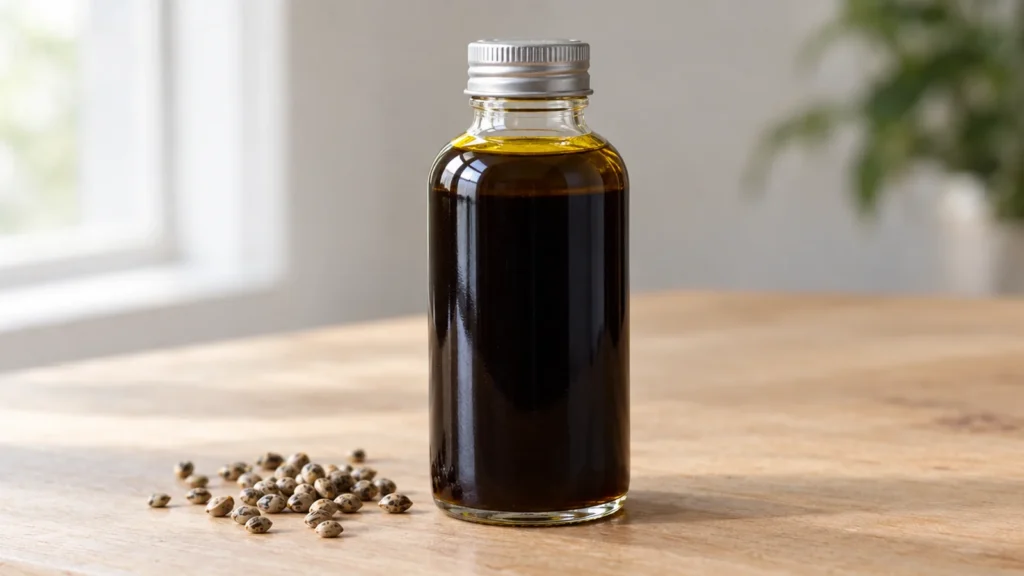
Cold-pressed, unrefined hemp seed oil is a dark green to brown oil with a mild, nutty scent. That is not a defect, it is what pressing seeds does. The pigments and the natural aroma come with the same process that preserves the fatty acids.
There are two ways to handle it, and both are common:
- Design around it. Use the oil in products where a warm, plant-like colour and a nutty note are acceptable or even desirable, such as body oils, balms, hand creams and hair products.
- Move to a lighter grade. If your face serum needs to be pale and nearly odourless, talk to your supplier about refined or lighter-coloured options and adjust your claims accordingly.
What you should not do is assume that the oil in the reference sample will look the same as the oil in the next delivery. Ask for the colour specification and for a sample from the batch you will actually buy.
The trade-off also shows up in shelf life. Chlorophyll and other pigments oxidise, so unrefined oil keeps for less time than a refined grade. Our cold-pressed oil carries an 18 month shelf life from production when stored properly; refining removes the compounds that drive oxidation and typically buys more time, at the cost of the antioxidants and the character that make unrefined oil interesting. If your formula needs a long shelf life in a warm market, that is a decision to make early, not at packaging stage.
Stability, oxidation and packaging
Hemp seed oil is high in polyunsaturated fat, which makes it oxidation sensitive. Handle it like the valuable ingredient it is:
- Keep it cool, dark and sealed, and store bulk containers away from heat sources
- Use opaque or amber packaging for consumer products where the oil is a visible phase
- Check peroxide value as part of your incoming goods routine
- Plan your shelf life with your formulator. Our cold-pressed oil carries an 18 month shelf life from production when stored properly
Natural tocopherols slow oxidation down, but they do not stop it. If your formula has a long shelf life in a warm market, plan for an antioxidant in the system or choose a package that limits light exposure.
What should you specify when sourcing hemp seed oil?
When you move from testing to production, the specification matters more than the marketing page. Ask any supplier for these, and compare the answers:
- Process: cold-pressed and unrefined, or refined. Confirm the pressing temperature and whether solvents are used
- Specification sheet with the fatty acid profile, peroxide value, moisture and microbiology
- Certification: EU Organic (we hold EE-ÖKO-03) and food safety certification such as BRCGS if the same oil also goes into food projects
- Traceability: where the seed was grown, who pressed it, and how batches are identified
- Packaging and volumes: 25 kg units for trial and small production, 1000 litre IBC containers for industrial volumes
- Logistics: whether the supplier ships worldwide and can hold a delivery schedule
A supplier who can answer all six in one document is a supplier you can put into a product information file.
Why origin and traceability matter more in cosmetics
Cosmetic brands carry claims on the front of the pack: organic, natural, sustainably sourced, made in Europe. Each of those claims has to be documented somewhere, and ingredient sourcing is usually where the weak link sits.
Nordic Hemp grows hemp on 5,000 hectares of Estonian farmland and presses the seed oil ourselves. That means the chain from field to IBC container runs through one company, not three. For a brand that needs to explain where its hemp comes from, that is a practical advantage, and it is one of the questions we get asked most often by formulators.
Claims and documentation your brand will need
Cosmetic claims get audited, so the ingredient paperwork has to hold up. When hemp seed oil goes into a product that carries an organic claim, a natural claim or a made in Europe claim, these are the documents that matter:
- Organic certificate covering the oil you buy, with the certification body and certificate number
- Specification sheet and certificate of analysis for the batch you receive
- Technical data sheet and safety data sheet (TDS and MSDS) for your own product information file
- Declaration on processing, stating cold-pressed and unrefined if that is what your label says
- Traceability statement naming the country of origin and the pressing site
- Allergen and safety documentation your toxicologist will ask for when the product information file is assembled
Ask for the full pack before the first production order, not after. Suppliers who work with brands keep it ready, and having it says something about how the rest of the cooperation will go.
Common questions from formulators
Can hemp seed oil be used in cosmetic formulations?
Yes. Hemp seed oil is a standard cosmetic ingredient. CosIng, the European Commission’s ingredient database, lists it with skin conditioning and emollient functions, and it is used as a carrier or oil-phase ingredient in serums, creams, lotions, balms and hair products across the European market.
Is hemp seed oil comedogenic?
No, it is generally regarded as non-comedogenic. Its high linoleic acid content and light texture mean it absorbs quickly instead of sitting on the surface, which is why it appears in formulas for combination and blemish-prone skin.
How much hemp seed oil is used in a formulation?
It depends on the product type. Face oils and serums often use it at 50 to 100%, creams and lotions at 1 to 15%, body products at 10 to 30%, cleansing oils at 30 to 50% and hair products at 1 to 20%. Your formulator sets the final rate. We supply the fatty acid profile and a sample so you can test the loading in your own base.
What is the difference between hemp seed oil and hemp oil?
In cosmetics, they usually mean the same cold-pressed seed oil. In the market generally, the term hemp oil is used loosely for several products with very different compositions. The reliable way to tell is the supplier’s technical documentation, which carries the official ingredient designation for the oil you buy. Read more about what hemp oil is.
Can the oil be used in products for oily skin?
It can, and it often is. The oil is light and non-comedogenic, so it does not add the heaviness that puts consumers off oil-based products. Formulators usually pair it with lighter esters or use it at a modest share in the oil phase.
Is your hemp seed oil organic?
We hold EU Organic certification (EE-ÖKO-03) and can supply both organic and conventional oil depending on your project. The certificate and the specification are available on request.
How should the oil be stored before production?
Cool, dark and sealed. Keep bulk containers out of direct light and away from heat, and keep the container closed between uses. Our cold-pressed oil carries an 18 month shelf life from production when stored under these conditions.
Formulating with hemp seed oil?
Nordic Hemp supplies cold-pressed, EU Organic-certified hemp seed oil to cosmetic and food manufacturers worldwide, in 25 kg units and 1000 litre IBC containers.
Request the specificationSources
- Nordic Hemp: Cold-Pressed Hemp Seed Oil product page
- European Commission CosIng: hemp seed oil ingredient entry (skin conditioning and emollient, CAS 89958-21-4)
- Pharmaceutics: Comprehensive Insight into Cutaneous Application of Hemp
- Journal of Cosmetic Medicine: regulatory and scientific insights into hemp seed extracts for skincare
- Journal of Dermatological Treatment: Efficacy of dietary hempseed oil in patients with atopic dermatitis