First-Time Hemp Grower: 59 Hectares in Europe (2026 Case Study)
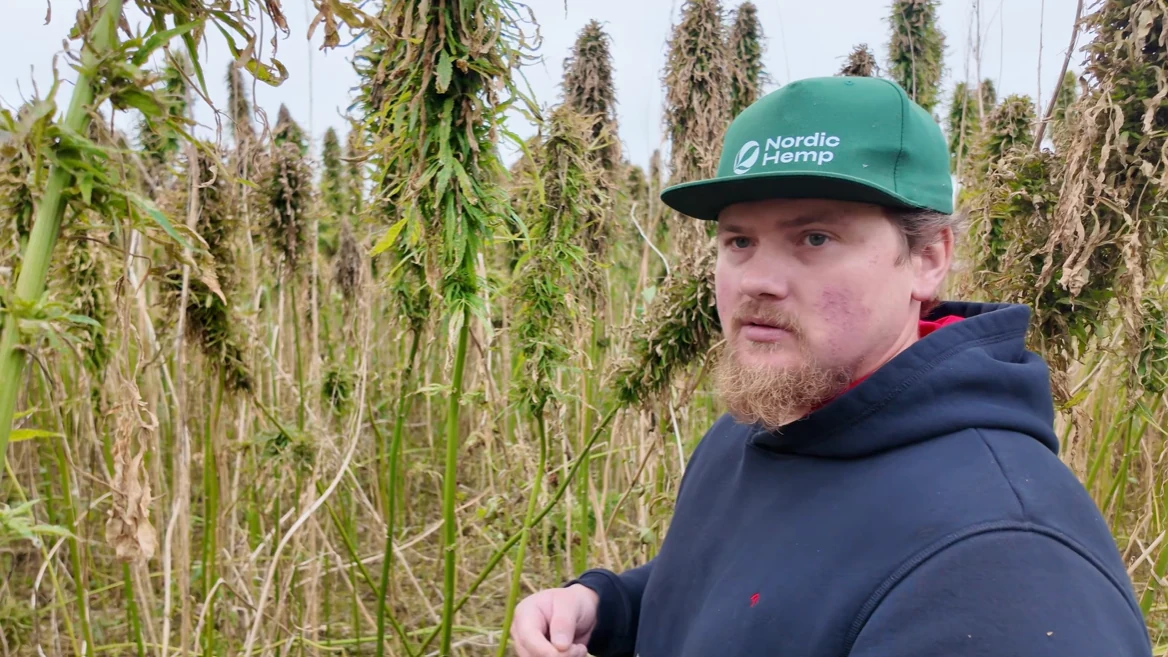
Joonas Põllumäe, Nordic Hemp’s raw material quality manager, inspecting the crop on Tõnis Saaval’s field.
Most advice about growing hemp comes from extension bulletins and trial plots. Useful, but generic. This is something else: one Estonian farmer documented his entire first season on video, from soil preparation to the combine, including the day a hailstorm flattened one of his fields. Below is what actually happened on 59 hectares in 2026, with the numbers, the mistakes and the fixes.
How this case study was made: Tõnis Saaval grew his 2026 hemp crop in cooperation with Nordic Hemp, and the season was filmed together with us. We buy what farmers like him grow, seed from the field goes through the same quality checks we apply to the seed we buy, and we run an annual hemp growing information day for Estonian farmers together with agronomists, researchers and experienced growers.
Part of our series on growing hemp for seed: Harvesting hemp with a combine · Drying and storing hemp seed
A first-year hemp crop in Estonia was sown in mid-May at 34 kg per hectare, at 1.5 to 2 cm depth, on 59 hectares. A hailstorm on 21 June destroyed one of the two fields; the crop recovered and pushed new stems from the broken ones within nine days. Harvest started in October and delivered roughly 1 tonne per hectare. The two biggest lessons were operational: never roll a hemp field after sowing, and cut as high as possible so the tough fibre does not wrap around the combine.
The farm behind this case study
The farmer is Tõnis Saaval, who runs a small arable farm in Estonia and has been farming for 15 years. He had never grown hemp before 2026. He planted 59 hectares in cooperation with Nordic Hemp and published the season as a video diary, episode by episode.
That last detail matters. Almost everything below was recorded on the day it happened, including the parts that went wrong.
Field preparation and sowing
The hemp went onto a field that had carried winter wheat, followed by a cover crop mix of phacelia, oilseed radish and buckwheat. Preparation was two cultivation passes, 20 cm and then 30 cm, with variable-rate NPK 10-26-26 at 64 to 174 kg per hectare plus 100 to 150 kg per hectare of nitrogen before sowing.
Sowing happened in mid-May at 34 kg per hectare with the Estica variety, at 1.5 to 2 cm depth. A calibration problem on the drill accidentally put three rates on the field, 25, 34 and 43 kg per hectare, and all three came up. After sowing, hemp needs very little: no herbicide, no fungicide, no insecticide.
We cover the drill setup, depth control and the rolling mistake in detail in "sowing hemp: depth, rate and the rolling mistake", a separate part of this series.
What happened on 21 June?
A severe storm crossed the farm on 21 June. Hailstones up to 2 cm across fell for two to three minutes.
Tõnis had two hemp fields separated only by a road, about 15 metres apart. One took a direct hit and was stripped down to bare stalks. The other was untouched, and so were the neighbouring wheat and barley fields. The damaged field was roughly 10% of his total hemp area.
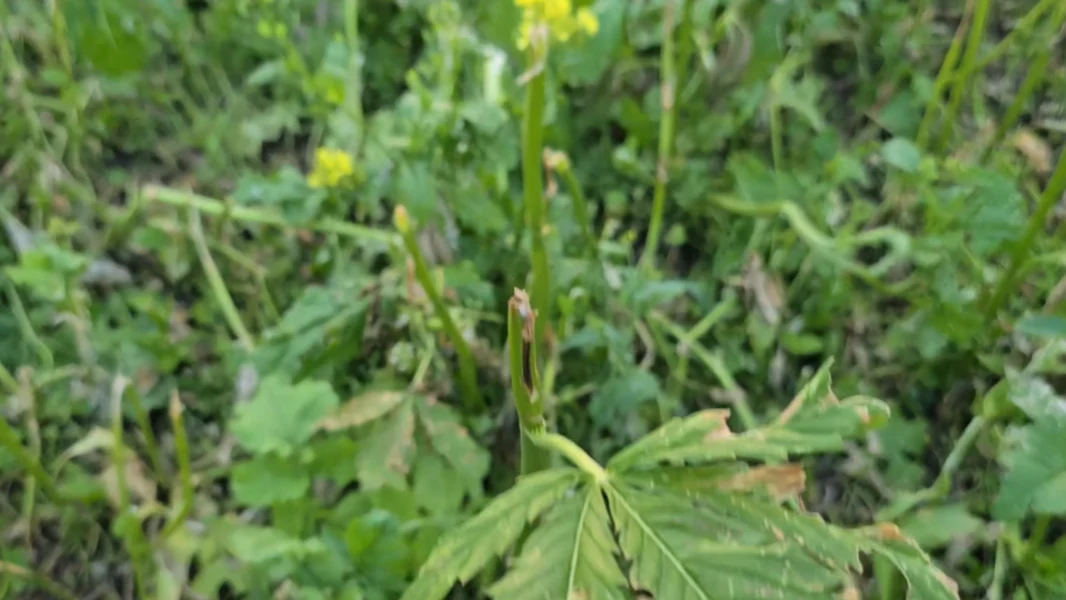
Filmed on 21 June. The video is in Estonian; press play, then switch on subtitles or auto-translate them in the player. Watch on YouTube
Did the crop recover?
It did, and faster than anyone expected. Recovery was helped along with a foliar spray of amino acids, seaweed extract and microelements, applied after advice from other growers. Nine days after the storm, new leaves were pushing out of the leaf axils of the broken stems, and by late July the field looked like a hemp field again, if thinner and weedier than the untouched one.
The full documentation of that recovery, from the day of the storm to the harvest, is in "hail on a hemp field", a separate part of this series.
By August, the field was weed-free without any spraying
In early August the untouched field had no weeds at all, in a crop that had received no herbicide. Hemp grows fast enough, and closes its canopy densely enough, to shade weeds out, and the same held in a neighbouring organic field.
There is a condition attached, and it is the important part: this only works if the crop establishes evenly and has enough nutrients. On the hail-damaged field, exactly the opposite happened, and the weeds moved in.
How do you know when hemp is ready to harvest?
The field still looks green when the seed is ripe, so it cannot be judged by colour the way wheat is. Seed matures from the bottom of the flower head upwards, and the practical target is around 80% mature seed. The check is manual: break off one flower head, open the green husk, and press seeds from top, middle and bottom between your fingers.
Variety matters here. Older varieties such as Finola shatter easily once the plant browns, forcing an early harvest. Estica holds its seed much more tightly, which buys flexibility on timing. By the end of September the verdict was that the crop was ready.

Harvesting hemp with a combine
This is where a first-year grower earns his education. Hemp fibre is strong enough to wrap around rotating parts, and once it does, friction builds fast. On this farm the exposed 10 to 15 cm of the drive shafts wrapped, creating smoke and a small flame. The fix was cheap: custom sheet-metal guards. After that, 7 to 8 hectares were harvested without a single wrap, at 5 to 6 tonnes per hour.
The wrapping problem, the flame, and the guard-plate fix, filmed during the October harvest.
Header height, machine protection, combine types and the settings that work are all covered in harvesting hemp with a combine.
What did the field actually yield?
Roughly 1 tonne per hectare of clean, dry seed, which is in line with what we see from first-year hemp fields in Estonia.
The more interesting number is how much was left in the field. Together with researchers from the Estonian University of Life Sciences, samples of one quarter of a square metre were taken from five positions in three replicates, and the seed was threshed by hand to measure the biological yield. On a comparable field, the standing crop carried 2.8 tonnes per hectare. The combine brought in about 1,050 kg.
That is a loss of roughly 62%, and it is the single biggest economic fact about hemp seed production: uneven ripening, a short harvest window and machine settings all take a slice. Published research from Canada and the United States reports harvest losses in a similar range, and European studies put combine losses around 30% below hand-harvested yields.
Is growing hemp profitable in the first year?
We cannot answer that yet. The last fields are still being harvested, and the crop has not been assessed yet.
And the price is not the only thing that decides the outcome. Yield, weather and harvest losses matter just as much, and all three are outside anyone’s control.
This season shows both sides. Hail hit the field in June. The standing crop carried 2.8 tonnes per hectare. At harvest, 62% of that was lost. What came in was about 1 tonne per hectare of clean, dry seed.
We will update this section once harvesting is finished and the crop has gone to its buyer.
Three things decide the result:
- Yield. How much the field gives you, after the weather has had its say.
- Harvest losses. A combine brings in well under the standing crop, especially in the first year.
- Price. Agree it before sowing. Without a contract, a hemp crop is a speculation, not a rotation.
We do not publish buy-in prices. The price depends on quality, variety and timing.
Is demand for hemp seed growing?
Yes, and the growth is coming from outside Europe. US demand for hemp seed has grown sharply in the last three to four years. Most of that supply came from Canada, the world’s largest hemp grower.
Then the tariffs changed the maths. US tariffs on Canadian hemp made Canadian seed more expensive for US buyers. Ardi Oja, our CEO, put it plainly at our 2026 information day for growers. Some of that demand is now looking to Europe. Asia is still a small market for hemp seed, but it is expanding.
On the price side, Ardi describes the market as unusually steady. The 2022 rise and the 2023 dip barely moved hemp seed prices. Organic prices move less than conventional ones.
What happens after the combine?
Seed quality can be lost in a single night: wet hemp seed left in a trailer overnight develops yeast, mould and bacterial counts fast enough to fail food-grade specification. Drying starts immediately, in an indirect-fired dryer, at a maximum of 45 to 50 °C, and the seed is stored at 6 to 9% moisture.
Those numbers are not generic advice. They are the specification that decides whether a load is accepted, and they are covered in full, with the quality checks behind them, in drying and storing hemp seed.
What does this mean if you are considering hemp in 2027?
Three conclusions from one first season:
- Establishment is everything. Sow shallow, do not roll, and make sure the crop can close its canopy. After that, hemp largely looks after itself.
- Plan the harvest before you sow. Guards on the exposed shafts, sharp knives, a high header setting, high fan speed, and fire equipment at hand.
- Talk to your buyer early. Seed moisture, drying temperature and storage decide whether your crop meets food-grade specification, and those decisions happen in the hours after harvest.
We contract hemp with growers in Estonia each spring, with the price fixed in advance, and we buy on the open market as well. If you are considering your first hectare, get in touch before you order seed, not after.
Planning a hemp crop?
Talk to us about varieties, agronomy and buying terms before the season starts.
Frequently asked questions
Can hemp survive hail damage?
Often yes. A field stripped to bare stalks on 21 June pushed new growth from the broken stems within nine days and produced a harvestable crop. Expect a yield loss and more weed pressure.
How much hemp seed does a first-year field yield?
About 1 tonne per hectare of clean dry seed is a realistic first-year figure in Estonia. Measured biological yield can be far higher, up to 2.8 tonnes per hectare, with most of the difference lost at harvest.
Is growing hemp profitable in the first year?
We cannot say yet. The last fields are still being harvested and the crop has not been assessed. The result will depend on yield, weather, harvest losses and the price in the contract. This field gave about 1 tonne per hectare, after losing 62% of the standing crop at harvest.
Do you need a buyer before you plant hemp?
Yes. Hemp is grown on contract rather than sold on a cash market, so the buyer, the variety and the quality requirements should be agreed before sowing.
Does hemp need herbicide?
Not if it establishes evenly. A dense hemp canopy shades out weeds on its own, which was the case in both a conventional and an organic field on this farm. Patchy establishment is what lets weeds in.
What is the hardest part of growing hemp?
The harvest. Sowing and growing are straightforward once the crop establishes, but combining hemp takes specific machine preparation because the fibre wraps around rotating parts.

This case study is updated as the season closes: at the time of writing, the last fields were still being harvested, so final yield and quality figures will be added.
Sources and further reading
- Farmer Tõnis, hemp growing series in cooperation with Nordic Hemp: youtube.com/@farmertonis (episodes 2 to 8, Estonian)
- Nordic Hemp, hemp cultivation information days for growers: youtube.com/@nordichempcooperation
- Successful Farming / Pennsylvania Hemp Industry Council on hemp contracts and profitability: agriculture.com
- University of Missouri Extension, harvesting industrial hemp: extension.missouri.edu/publications/mx79