Hempseed Shells vs Soybean Hulls, Beet Pulp and Wheat Bran
Last updated: October 28, 2026
Soybean hulls, beet pulp and wheat bran are fibre ingredients a formulator already knows. Hemp hulls arrive as the fourth option, usually with no analysis attached and no obvious place in the ration. Nordic Hemp supplies organic hemp hulls in bulk for feed use. Setting the four against each other on the same measurements is the only way to see which gap each one fills.
The figures below come from published composition tables for the three established ingredients, and the article says plainly where the hemp data is weaker. It is written for someone building a ration.
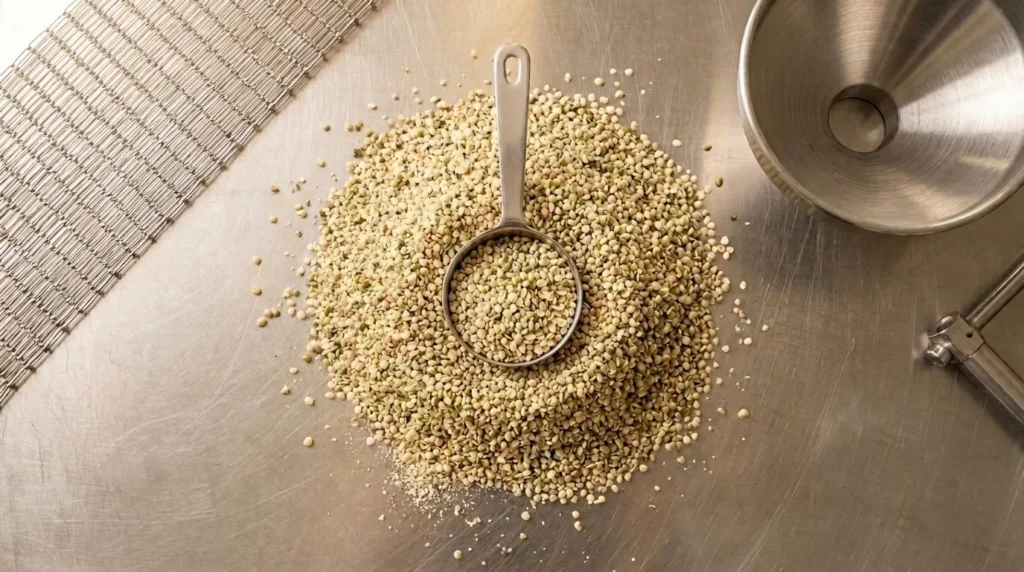
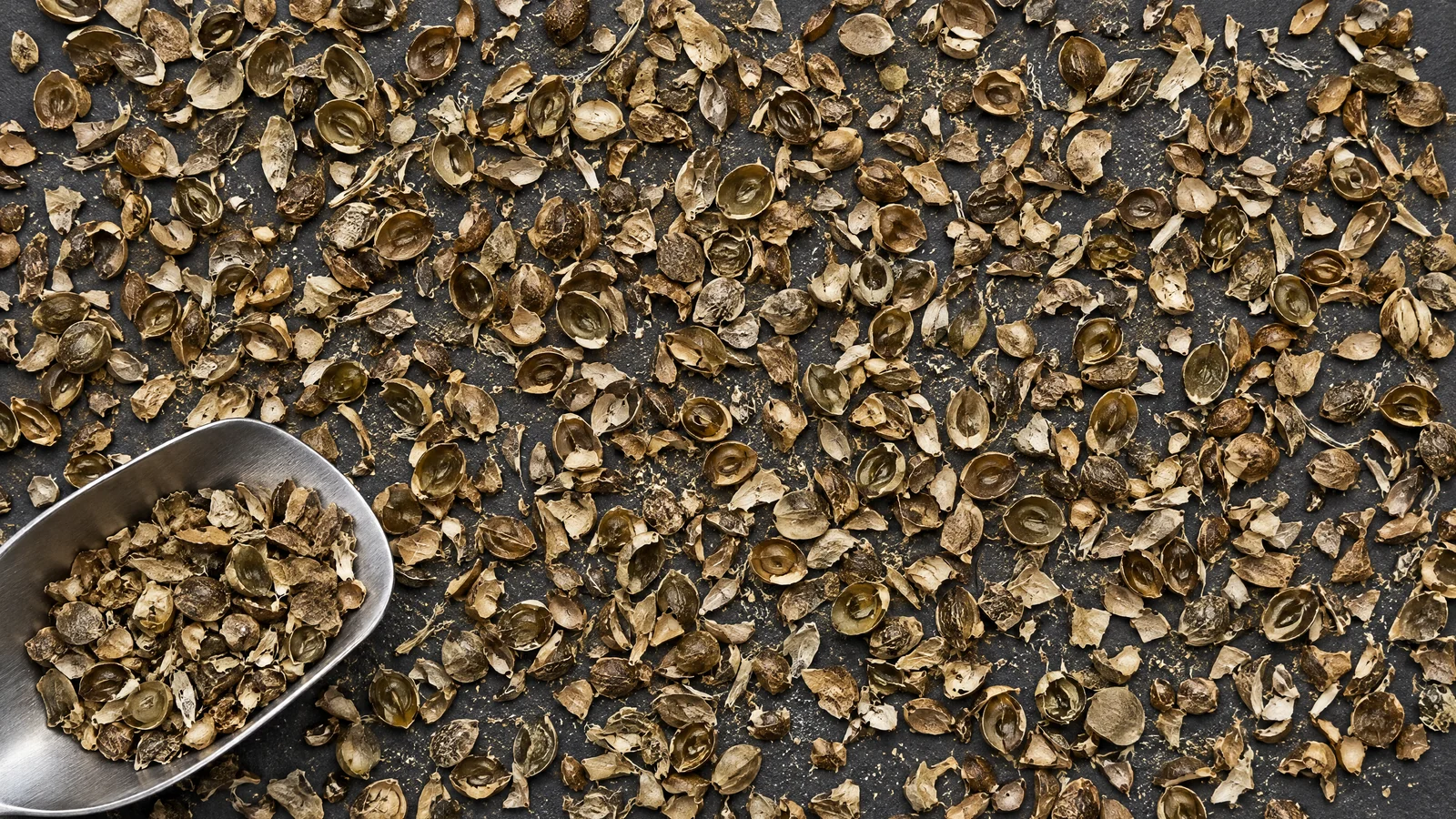
Hemp hulls sit closest to soybean hulls on fibre content, at roughly 65% neutral detergent fibre, but the fibre is more lignified, so less of it is digestible. Soybean hulls behave partly like an energy feed. Beet pulp is lower in fibre but highly digestible, which makes it an energy-bearing fibre for dairy. Wheat bran sits lower on fibre and higher on protein and starch. Hemp hulls are bulk fibre: rumen fill and structure at low energy cost, which fits dry cows, growing heifers, ewes, lambs and horses and fits badly in a high-yielding dairy ration. Ours comes off our own line in Estonia, dried within a 45 to 50 degree ceiling, not pelleted and not blended.
NDF
NDF
NDF, dehydrated

- Where do hemp hulls sit among fibre ingredients?
- How do hemp hulls compare with soybean hulls?
- How do they compare with beet pulp and wheat bran?
- Where the hull in the bag comes from
- Why does the drying regime change the hull you receive?
- The numbers side by side
- Which fibre source fits which ration?
- What this comparison does not prove
- What should you specify before you buy?
- Frequently asked questions
Where do hemp hulls sit among fibre ingredients?
Beet pulp is the residue of sugar extraction, and its pectin-rich fibre ferments well, which is why it behaves more like an energy feed than its fibre figure suggests. Soybean hulls are the seed coat, removed before oil extraction, light in lignin and rapidly fermented. Wheat bran is a milling fraction with a genuine protein and starch content, so it earns its place twice over. Hemp hulls are the seed coat removed before the kernel is sold or pressed,
There is one structural difference the composition tables cannot show. Three of these four are residues of somebody else’s process, and only the hemp hull is the first fraction of a line built to produce food ingredients, separated before any further processing happens to the kernel.
For the product definition, the fibre profile and the species fit, start with our guide to hempseed shells as livestock feed.
How do hemp hulls compare with soybean hulls?
Soybean hulls run at roughly 64% neutral detergent fibre and about 46% acid detergent fibre, with very low lignin, in the region of 2%. Hemp hulls run at roughly 65% neutral detergent fibre, and the acid detergent fraction is high because the hull is a lignified outer coat.
That difference shows up in the energy figure. Published total digestible nutrients for hemp hulls sit at about 52%, while soybean hulls are valued much higher because their fibre actually ferments. Soybean hulls work in dairy rations as a partial forage replacer that also contributes energy. Hemp hulls cannot do that; they fill space and provide structure at a low energy cost, which is a different job.
The one place the two line up is physical handling: neither needs pelleting, and both mix into a total mixed ration without segregating. So if you are replacing soybean hulls to keep energy in the ration, hemp hulls are not the substitute. If you are replacing part of the forage in the dry-cow or youngstock group with something bulky and low in energy, they are.
How do they compare with beet pulp and wheat bran?
Beet pulp is the benchmark for a fibre that behaves like an energy feed. Dehydrated beet pulp carries about 47% neutral detergent fibre and about 24% acid detergent fibre, with lignin around 3%, metabolisable energy published at around 11.4 megajoules per kilogram of dry matter and organic matter digestibility near 84%. That is why it supports milk yield and keeps rumen function stable when forage quality is poor. Hemp hulls offer more fibre and far less usable energy: they occupy rumen space without returning much, which is what you want in an animal that should not gain condition quickly.
One practical point favours the hull. Pressed beet pulp is a high-moisture, sticky material that has to be managed as such, while hemp hulls leave our line at the moisture the seed was dried to, between 6 and 9 percent, and stay a free-flowing flake.
Wheat bran is the odd one out, because it is not really a fibre decision. Bran carries about 44% neutral detergent fibre but only about 15% acid detergent fibre, with lignin around 4%, plus roughly 17% crude protein and a substantial starch fraction, so it is bought for fibre and protein together. Hemp hulls carry more fibre, far less digestible energy and less protein, which makes them a straight bulk swap that only makes sense where the ration already has enough protein and the constraint is physical fibre volume.
Where the hull in the bag comes from
The hemp is grown under contract on 5,000 hectares in Estonia and processed in our own facility. The seed we dehull is Estica, our own variety. Estica is large-seeded, with 95 percent of the seed running over 3 millimetres and oil content up to 35 percent, and a larger, more uniform seed cracks more cleanly on a dehulling line.
The chain runs across two sites. Each incoming lot arrives first at our warehouse in Mustvee, 3,000 square metres, and only moves to the processing plant in Vahi, 1,500 square metres, after intake quality control. At intake a sample goes through a small-scale dehulling trial and a colour check, so the behaviour of that seed is known before the lot is committed to the line. The line carries an optical sorter running at 300 to 600 kilograms per hour that ejects material on colour, which removes what a camera reads as dark, discoloured or foreign rather than grading by size.
Raw seed intake runs to 3,000 tonnes a year and the dehulling side to 1,000 tonnes of seed across two shifts, which is the volume the shell fraction scales with. Every tonne of arriving seed is processed into finished food ingredients and raw seed is not resold. Hemp is grown without herbicides, fungicides and insecticides, with weed control coming from sowing density at 120 to 130 seeds per square metre and from the canopy closing over the row. The site is certified under EU Organic, registration EE-ÖKO-03, and operates to BRCGS, Brand Reputation through Compliance Global Standards. We sell business to business, ship worldwide, and our hemp ingredients reach 26 countries.
Why does the drying regime change the hull you receive?
Two hulls can carry the same neutral detergent fibre figure and behave differently in your intake, and the reason usually sits in a dryer months earlier.
Hemp seed comes off the combine wet enough to spoil, so drying is immediate. Our dryers are indirect fired, so combustion gas never touches the seed, and the ceiling is 45 to 50 degrees Celsius. Above 50 degrees the seed coat cracks, oxygen reaches the kernel underneath, and oxidation starts in the store before the lot has been processed.
For a feed buyer the consequence is physical. A coat dried within limits is intact and holds its curved flake shape. A coat that ran hotter carries fracture lines and breaks into more small fragments as the line handles it, so the material arrives with a different fines curve, dust load and flow in a silo. Nothing on a fibre analysis shows it.
Our dryer exits at 6 to 9 percent seed moisture, targeting 8 percent, and that is the moisture the coat carries when it is separated. Polycyclic aromatic hydrocarbons are tested on incoming material, and a lot with a PAH sum above 10 does not go into food use; those samples are analysed in a laboratory in Germany. After drying, seed is held in closed bags on pallets, below 15 degrees Celsius and out of the light.
This is the variable to ask about when two hemp hull offers look identical on paper.
The numbers side by side
All values are percentages of dry matter unless stated. Soybean hulls, beet pulp and wheat bran are Feedipedia averages; hemp hull values are published figures, with the lot analysis taking precedence.
| Neutral detergent fibre | Hemp hulls about 65. Soybean hulls about 64. Beet pulp about 47. Wheat bran about 45. |
| Acid detergent fibre | Hemp hulls high and lot-specific. Soybean hulls about 46. Beet pulp about 24. Wheat bran about 13. |
| Lignin | Hemp hulls high and lot-specific. Soybean hulls about 2. Beet pulp about 3. Wheat bran about 4. |
| Crude protein | Hemp hulls about 14. Soybean hulls about 13. Beet pulp about 9. Wheat bran about 17. |
| Total digestible nutrients | Hemp hulls about 52. The other three are valued materially higher. |
| Moisture at separation | Hemp hulls 6 to 9 percent. Not comparable with pressed beet pulp, which carries far more water. |
Which fibre source fits which ration?
| High-yielding dairy cows | Beet pulp or soybean hulls. Both bring usable energy with the fibre, which is what a high group needs. |
| Dry cows and growing heifers | Hemp hulls. Bulk and structure with low energy is the correct profile for an animal that should hold condition rather than gain it. |
| Ewes and growing lambs | Hemp hulls, supported by published trial work in sheep. Weight gain was not affected at the inclusion levels tested. |
| Horses | Hemp hulls as a forage extender. The hindgut is built for fibre fermentation and a dry, bulky material stores easily. |
| Rations short of protein | Wheat bran, or a protein feed. Hemp hulls will not close a protein gap. |
What this comparison does not prove
There is no published head-to-head feeding trial that puts hemp hulls against soybean hulls, beet pulp or wheat bran on animal performance. The published hemp hull figures come from a composition table built on a commercial product specification, and the one recent ruminant study measured hemp hulls against wheat screenings in sheep, not against the other three ingredients. The ranking is one of composition and function, not of measured animal response.
The other limit is variability. A lignified seed coat is not a manufactured ingredient, and the shell fraction moves with variety, seed size and drying history. We report measured values per lot rather than an industry average; published averages start a conversation with a supplier rather than a formulation.
What should you specify before you buy?
Four things decide whether a lot is right for your ration, whichever fibre source you are buying.
- The fibre fractions for that lot. Neutral detergent fibre, acid detergent fibre and acid detergent lignin together, plus crude protein, fat, ash and moisture.
- Bulk density and particle size range. A light, dry flake fills a silo by volume long before it fills it by weight, and generates dust at the intake.
- Processing history and drying regime. Ask at what temperature the seed was dried and how the hull was separated, because that is the one variable that changes physical behaviour without moving any number on the analysis.
- Organic status and certification. If the ration has to carry an organic claim, the certificate has to match the lot.
The documentation should cover all four and arrive before the first trailer does.
Comparing fibre sources for a ration?
Nordic Hemp grows hemp on 5,000 hectares in Estonia and processes it in its own facility, from intake quality control to the dehulling line. We supply organic hemp hulls in bulk for livestock feed, with a certificate of analysis and full documentation per lot. Send us your ration requirements and we will send the lot analysis for the material we have in stock, plus shipping details.
Ask us about hemp hulls See the product specificationFrequently asked questions
Are hemp hulls a substitute for soybean hulls?
Only partly. Hemp hulls sit within a point of soybean hulls on fibre, at roughly 65% and 64% neutral detergent fibre, but the fibre is more lignified and delivers far less energy. They replace soybean hulls as bulk fibre only.
Can hemp hulls replace beet pulp?
Not in a high-yielding ration. Beet pulp carries about 47% neutral detergent fibre, high digestibility and around 11.4 megajoules of metabolisable energy per kilogram of dry matter, so hemp hulls fill a different gap.
How do hemp hulls compare with wheat bran?
Bran carries about 44% neutral detergent fibre, around 17% crude protein and a starch fraction, so it is bought for fibre and protein together. Hemp hulls carry more fibre, less protein and far less digestible energy.
Why is lignin more important than the fibre number?
Neutral detergent fibre counts the whole cell wall; lignin is the part a rumen cannot break down. Two materials can show the same fibre figure and behave completely differently, as hemp hulls and soybean hulls do.
Is there published trial evidence for hemp hulls in ruminants?
One recent Canadian study fed hemp hulls to growing lambs and lactating ewes and measured rumen degradability. Intake rose against wheat screenings while weight gain was unaffected, which justifies a trial rather than a general inclusion level.
Where do Nordic Hemp hulls come from?
From hemp grown under contract on 5,000 hectares in Estonia and processed in our own facility. Each incoming lot is held at our Mustvee warehouse for a dehulling trial and a colour check before it moves to the plant in Vahi.
Does drying temperature change how a hemp hull compares with other fibres?
It changes the physical condition of the hull without moving the fibre figure. Hemp seed is dried at no more than 45 to 50 degrees Celsius and exits at 6 to 9 percent moisture; above 50 degrees the coat cracks and oxidation starts in the store.
Sources
Peer-reviewed and trade sources used for the figures in this article.
- Feedipedia. Soybean hulls. Composition and nutritive value tables, INRA, CIRAD, AFZ and FAO.
- Feedipedia. Beet pulp, dehydrated. Composition and ruminant nutritive value tables, INRA, CIRAD, AFZ and FAO.
- Feedipedia. Wheat bran. Composition table, INRA, CIRAD, AFZ and FAO.
- Washington State Department of Agriculture. Report to the Legislature on hemp seed products as feed ingredients for laying hens. Composition summary including hemp seed hulls.
- Agricultural Utilization Research Institute (AURI). Energy and crude protein comparison of hemp coproducts with main livestock feedstuffs, total digestible nutrients on a dry matter basis.
- Evaluation of hemp hulls and screenings as alternative feed ingredients for ruminants (2026). Canadian Journal of Animal Science.
- EFSA Panel on Additives and Products or Substances used in Animal Feed (2011). Scientific opinion on the safety of hemp for use as animal feed. EFSA Journal 9(3): 2011.