Organic vs Conventional Hemp Hearts: What Food Manufacturers Need to Know
When sourcing hemp hearts for your food products, one of the first decisions you will face is organic or conventional. The choice affects your pricing, your labelling, and your market access. But what is the actual difference between the two, and how do you decide which one fits your product?
Quick answer
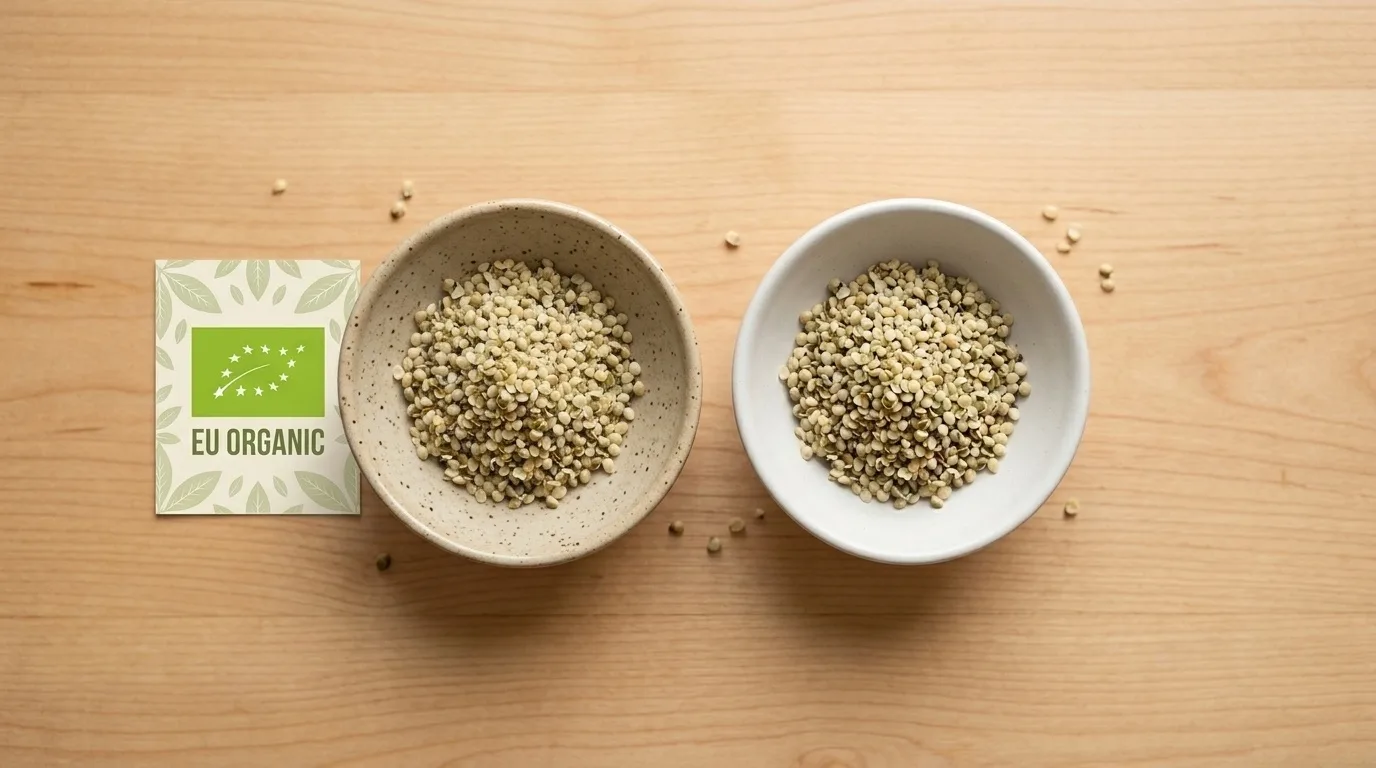
Organic hemp hearts are grown without synthetic pesticides, herbicides, or fertilisers, and are certified by an EU-recognised control body. Conventional hemp hearts follow standard agricultural practices. Both are safe and nutritious — the choice depends on your market, budget, and product positioning. At Nordic Hemp, we supply both organic and conventional hemp hearts. Our organic line is certified under EU Organic (EE-ÖKO-03) and BRCGS food safety, giving you full traceability from field to finished product.
What does organic certification mean for hemp hearts?
Organic certification is not about the seed itself — hemp hearts are hemp hearts regardless of the label. The difference is in how the crop is grown, processed, and documented.
Whether you choose organic or conventional, the nutritional value of the seed itself is the same — explained in detail in our complete guide.
For a product to carry the EU Organic label, it must meet strict requirements. No synthetic pesticides, herbicides, or fertilisers. No GMOs. The soil must be farmed organically for at least two years before the crop is planted. Every step of the supply chain — from field to packaging — is inspected by an independent certification body.
In practice, this means organic hemp hearts come with a paper trail. Every batch can be traced back to the field it was grown in. The certification document is part of the shipping documentation, which buyers in regulated markets often require.
Conventional hemp hearts follow standard agricultural rules. Pesticides and synthetic fertilisers are permitted under national limits. The product is still food-grade and safe, but the documentation around growing practices is less detailed.
Both THC and CBD are naturally present in hemp hearts at trace levels — organic certification does not affect THC or CBD content. THC is regularly tested and stays below the EU legal limit of 3 mg/kg for seeds, regardless of growing method.
Organic hemp hearts — specs and certifications
At Nordic Hemp, our organic hemp hearts are grown from our hemp varieties on certified organic farmland across Estonia. The Nordic climate — long summer days, clean air, and mineral-rich soils — produces seeds with a consistently high oil and protein content.
Our organic hemp hearts are certified under:
- EU Organic (EE-ÖKO-03) — the European organic standard, audited annually by an independent certifier
- BRCGS Food Safety — Global Standard for Food Safety, recognised by retailers and manufacturers worldwide
We regularly test our raw material and final products. Standard packaging is 30 × 25 kg bags (750 kg per pallet).
Our RAK variety is the newest addition to the EU Common Catalogue of agricultural plant species, registered in 2025 — we are the sole official distributor of RAK planting seeds in the EU.
Conventional hemp hearts — what changes without organic certification
Conventional (non-organic) hemp hearts are grown with standard agricultural practices. Synthetic fertilisers and pesticides may be used within legal limits. The product is still food-grade and safe for consumption, but the certification framework is different.
Key differences:
- Farming inputs: Synthetic fertilisers and pesticides permitted under national regulations
- Documentation: Standard food safety documentation, but no organic certificate or supply chain audit
- Price: Typically lower, reflecting reduced certification and production costs
- Market access: Suitable for most food manufacturing applications, but may not meet organic label requirements for retailers
Conventional hemp hearts can still be high-quality and lab-tested. The difference is in the farming system, not the seed itself.
Side-by-side comparison: organic vs conventional hemp hearts
| Factor | Organic Hemp Hearts | Conventional Hemp Hearts |
|---|---|---|
| Pesticides | None — prohibited by organic standards | Permitted within legal limits |
| Fertilisers | Organic only (compost, green manure) | Synthetic fertilisers permitted |
| GMOs | Prohibited | Permitted (varies by region) |
| Certification | EU Organic (EE-ÖKO-03), BRCGS | Standard food safety |
| Protein content | 34g per 100g (variety-dependent) | 34g per 100g (variety-dependent) |
| THC / CBD | Naturally present below 3 mg/kg | Naturally present — same limits |
| Traceability | Full — field to finished product | Full — field to finished product |
| Price | Higher — certification + lower yields | Lower — fewer production constraints |
| Market access | Retail, organic-label products | General food manufacturing |
Price difference: is organic worth the premium?
Organic hemp hearts cost more than conventional. The price difference comes from real costs in the supply chain:
- Lower yields: Organic farming typically produces 20–30% less per hectare than conventional
- Certification costs: Annual audits, soil testing, and documentation add to the overhead
- Labour: Mechanical weed control instead of herbicides
- Supply chain segregation: Organic and conventional must be kept separate from field to packaging
Whether the premium is worth it depends on your market. If your customers expect organic labelling — retail brands, baby food manufacturers, health food products — the certification is a requirement, not an option. For industrial ingredients, bulk commodity products, or price-sensitive markets, conventional may be the right fit.
The price difference between organic and conventional hemp hearts is about the farming system and certification, not the nutritional value of the seed itself. Compare suppliers on lab testing, purity, and supply reliability — not just the price per kilogram.
Which should you choose?
There is no single right answer. Here is a practical guide based on what we see from our B2B customers:
Choose organic hemp hearts when:
- Your product carries an organic label or certification
- You supply retailers with organic requirements
- Your brand positioning is built on clean-label, natural ingredients
- You need full traceability and audited supply chain documentation
Choose conventional hemp hearts when:
- You are sourcing for a price-sensitive commodity product
- Your market does not require organic certification
- You are buying in very large volumes where the premium adds up
- You have your own quality control system and do not need third-party organic audits
At Nordic Hemp, we supply both organic and conventional hemp hearts. If you need organic-certified product with full traceability, lab testing, and reliable supply, we can help.
Common questions about organic vs conventional hemp hearts
Are organic hemp hearts more nutritious than conventional?
No — organic certification does not affect the nutritional profile of the seed. Protein, fat, and amino acid content depend on the variety and growing conditions, not the farming method. Our hemp varieties consistently deliver 34g protein per 100g across both organic and conventional growing methods.
Does organic certification affect THC content?
No. THC is naturally present in hemp seeds at trace levels regardless of how the crop is grown. Both organic and conventional hemp hearts are tested and stay below the EU legal limit of 3 mg/kg for seeds.
Is organic always better for the environment?
Organic farming avoids synthetic pesticides and fertilisers, which benefits soil health and biodiversity. However, organic yields are typically lower, meaning more land may be needed to produce the same volume. The overall environmental impact depends on many factors beyond certification alone.
Can conventional hemp hearts be used in organic products?
No — if your final product carries an organic label, every ingredient must be organic-certified, including hemp hearts. Mixing organic and conventional ingredients would break the certification.
Does Nordic Hemp supply both organic and conventional?
Yes — Nordic Hemp supplies both organic and conventional hemp hearts. Our organic line is certified under EU Organic (EE-ÖKO-03) and BRCGS food safety, while our conventional line follows standard food-grade practices with full traceability. Contact us for your specific requirements.
Need organic hemp hearts with full certification?
We supply certified organic hemp hearts to food manufacturers across Europe and worldwide. We regularly test our raw material and final products. Full documentation included with every order.
Request a quote →