What is hemp oil and what makes it so healthy? (2026 Complete Guide)
Last updated: September 28, 2026
Hemp seed oil is the oil pressed from hemp seeds, and it is one of the few plant oils that puts a meaningful amount of omega-3 in a bottle you can pour over a salad. It’s also one of the most misunderstood oils on the shelf. It isn’t CBD oil. It doesn’t get anyone high. And it should never go near a frying pan.
Nordic Hemp presses cold-pressed, EU Organic hemp seed oil from seeds grown on Estonian farmland. This guide covers what the oil actually is, what is inside it, what it is good for, how to use and store it, and what the research does and does not show.
Hemp seed oil is a cold-pressed oil made from hemp seeds, not from the flowers or leaves. It is rich in polyunsaturated fat, with an omega-6 to omega-3 ratio of around 3:1, and it also contains GLA and vitamin E. Use it cold: dressings, dips, drizzling, smoothies, or stirred into a finished dish. Its smoke point is around 165 C, so it is not a frying oil. Unopened, it keeps for 18 months when stored cool, dry and out of sunlight. Once opened, it belongs in the fridge.
What is hemp seed oil?
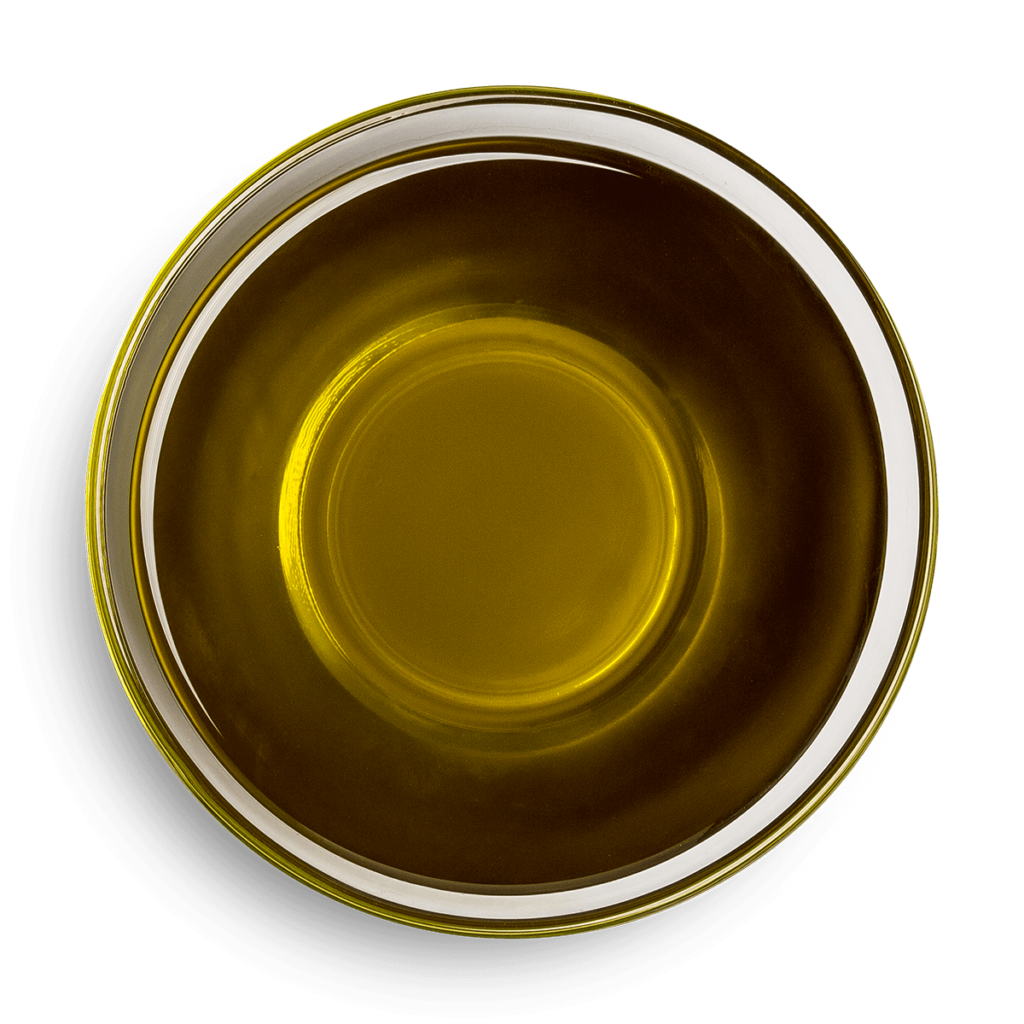
Hemp seed oil is a fatty oil obtained by pressing the seeds of the hemp plant. The seeds are mechanically crushed and pressed, without heat above roughly 40 C and without chemical solvents. That’s the whole process. What comes out is a dark green oil with a nutty, slightly grassy flavour.
The colour comes from chlorophyll, which the seeds carry into the oil during pressing. Colour intensity is a useful guide to taste: the darker the oil, the more intense and grassier it tends to be. Cold-pressed hemp seed oil is never completely clear. Clear, colourless hemp oil on a shelf has been refined, and refining removes much of what makes the oil interesting in the first place.
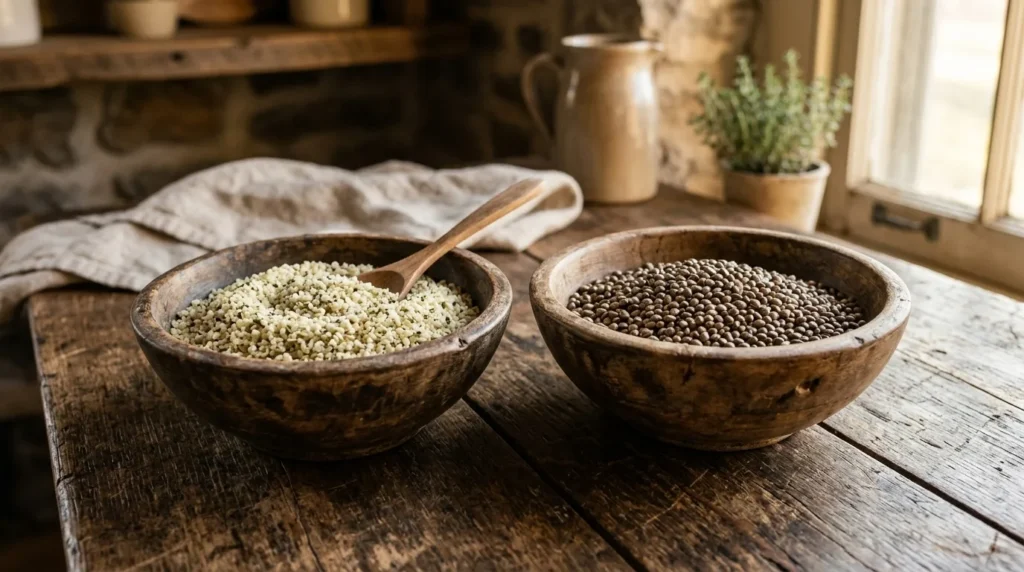
Two things are worth separating straight away. Hemp seed oil isn’t the same product as CBD oil, and it isn’t the same thing as hemp hearts. Hemp hearts are the hulled kernels of the seed, eaten as a food ingredient. Hemp seed oil is pressed from those same seeds and used as an oil.
How is hemp seed oil made?
It starts in the field. Hemp seeds are harvested at full maturity, dried and cleaned to remove plant debris and foreign material. Clean seeds then go into a press, where they are crushed slowly at low temperature so the oil separates without being damaged by heat. The oil is filtered and filled.
Nordic Hemp grows Estica and RAK hemp varieties on Estonian farmland and presses the oil in our own facility, which houses the largest hemp seed de-hulling facility in Europe. Production runs on a zero-waste basis: the pressed seed cake does not leave as waste. Because we control the chain from field to bottle, the oil we ship tastes the same this year as it did last year.
What is hemp seed oil used for?
Hemp seed oil has four main uses, and they look quite different from each other.
- In the kitchen. Salad dressings, vinaigrettes, dips, hummus, soups, drizzled over cooked vegetables, or stirred into a dish after the heat is off. It is a finishing oil, not a cooking oil.
- As a dietary source of omega-3. For anyone who does not eat oily fish, hemp seed oil is one of the few plant oils with a genuinely useful omega-3 content alongside its omega-6.
- On skin and hair. Hemp seed oil is used topically as a face oil, body oil and hair treatment. It absorbs reasonably quickly and does not sit greasy on the surface.
- As a food manufacturing ingredient. Food producers use it in dressings, sauces, dips and plant-based products, both for the flavour and for the nutritional story it puts on the label. We cover that side in detail in our food manufacturing guide.
Hemp seed oil nutrition and fatty acids
Here is the typical composition of our cold-pressed hemp seed oil per 100 g, based on our product specification.
| Per 100 g | Amount |
|---|---|
| Energy | 3761 kJ / 899 kcal |
| Fat | 99.76 g |
| Carbohydrates | 0 g |
| Protein | 0 g |
| Salt | 0 g |
| Moisture (max) | 0.5 % |
Almost all of that fat is unsaturated. The oil is dominated by two polyunsaturated fatty acids: linoleic acid, an omega-6, and alpha-linolenic acid (ALA), an omega-3. Hemp seed oil also contains gamma-linolenic acid (GLA), a less common omega-6 that appears in only a handful of seed oils, and vitamin E.
The headline number is the ratio. Hemp seed oil sits at roughly 3 parts omega-6 to 1 part omega-3. Most Western diets run closer to 10:1 or higher, so oil with a lower ratio gets attention from nutrition researchers. That ratio is the single most quoted feature of hemp seed oil, and it is the reason the oil shows up in so many omega-3 discussions.
What makes hemp seed oil healthy?
A 3:1 omega-6 to omega-3 ratio sits in the range that nutrition reviews have treated as favourable since Callaway’s hempseed overview in 2004, and ALA is an essential fatty acid the body cannot make on its own. For people who do not eat fish, that matters.
The more recent evidence is more interesting than the old marketing lines. A 2026 randomized, double-blind crossover trial published in Food & Function had 30 adults consume hemp products for four weeks. Blood analysis showed ALA, GLA, DGLA and EPA all rose in plasma and red blood cells, with no adverse changes in blood lipids, blood pressure or body composition. That is the first controlled human evidence that hemp-derived fatty acids actually reach the bloodstream in measurable amounts.
What the research actually shows
Precision matters here, because hemp seed oil is often sold with promises the evidence does not support.
An earlier randomized crossover study by Schwab and colleagues, published in 2006, compared hempseed oil and flaxseed oil in 14 healthy adults over four weeks. Hempseed oil raised serum ALA and GLA levels. Total, LDL and HDL cholesterol did not move.
Blood fatty acids up, cholesterol flat. That is what the study showed, and it leaves the case for hard cardiovascular outcomes unproven.
Rodriguez-Leyva and Pierce made the same case in 2010: the ratio looks favourable, and that is about where the evidence stops. They asked for bigger, longer trials. Sixteen years on, those trials have still not arrived.
On the skin side, a 2026 study in the Journal of Oleo Science found that cold-pressed hemp seed oil accelerated wound healing in laboratory tests and increased the proliferation of normal human dermal fibroblast cells by 72 percent at a concentration of 0.12 mg/mL. It is a petri-dish result, not a human one. Nobody has yet shown that this happens on real skin.
GLA is the component most often linked to inflammation. In the body, GLA is converted into DGLA, which sits on an anti-inflammatory pathway. This is a mechanism, not a treatment. It explains why researchers keep looking at hemp seed oil, and it does not turn a bottle of salad oil into a medicine.
Hemp seed oil is a nutritious culinary oil. It is not a treatment for pain, arthritis, inflammation or any other condition, and we do not present it as one. If you have a medical condition or take medication, talk to a doctor or pharmacist before adding any oil to your diet in large amounts.
Cold-pressed hemp seed oil: why it matters
Cold-pressing is not a marketing label. It describes a temperature limit. Our oil never goes above roughly 40 C during pressing, which keeps the delicate polyunsaturated fatty acids, the GLA and the vitamin E content intact.
Refined hemp oil takes the opposite route. The oil is treated with heat, filtration and often bleaching or deodorising to produce a clear, neutral liquid with a longer shelf life and a higher smoke point. The trade-off is that the refining process strips out a large part of the colour, flavour and nutritional profile.
We supply cold-pressed only, and we have written a full technical comparison for manufacturers: cold-pressed vs refined hemp seed oil.
Is hemp seed oil the same as CBD oil?
No. They come from the same plant, but from different parts of it, and they are not interchangeable.
Hemp seed oil is pressed from seeds. CBD oil is extracted from the flowers and leaves of the plant, which is where the cannabinoids sit. Seeds and flowers do not give you the same product, and no amount of processing changes that.
Hemp seed oil also will not make anyone high. THC in hemp seeds stays well below the EU limit of 3 mg/kg for seeds. We test our raw material and our finished products, and the oil is sold as a food ingredient, not as an intoxicating product.
Blame the naming. Everyday speech gave two completely different products the same label. The practical answer is to check what is actually written on the bottle. If it says hemp seed oil, it is a culinary oil. If it says CBD, cannabidiol or full-spectrum extract, it is something else entirely.
Can you cook with hemp seed oil?
Only gently. Hemp seed oil has a low smoke point, around 165 C, which is well below frying temperature. Push it past that and the omega-3s degrade, the flavour turns bitter and oxidation products start forming.
Where it works: dressings, vinaigrettes, dips, pesto, hummus, drizzled over finished vegetables, stirred into soup or pasta once the pan is off the heat. Where it does not: frying, searing, roasting at high heat or anything that keeps the oil in a hot pan for minutes.
If you want one oil for both jobs, you need two bottles. We compare hemp seed oil against the alternatives in our guides to olive oil, rapeseed oil and coconut oil.
How to use hemp seed oil for skin and hair
Hemp seed oil is generally considered non-comedogenic, which means it does not clog pores, and it is light enough to absorb without leaving a heavy film. That combination is why it appears in so many face oils and body products.
For the face, a few drops warmed between the palms and pressed into damp skin is usually enough. Patch test first if your skin is reactive. For the body and hair, it works as a massage oil, a scalp treatment before washing, or a few drops through the ends of dry hair.
The GLA content is what cosmetic formulators focus on, since it supports the skin’s lipid barrier. That’s a cosmetic argument, not a medical one: hemp seed oil can help skin feel comfortable and hydrated, and it isn’t a treatment for any skin condition.
How much hemp seed oil should you take per day?
There’s no official recommended daily amount for hemp seed oil. In research settings, studies have used roughly 30 to 45 ml per day as a dietary oil. In everyday use, one to two tablespoons is a common range, and a single spoonful is a sensible starting point.
Keep calories in mind. At around 899 kcal per 100 g, hemp seed oil is an energy-dense food, and a couple of tablespoons adds a meaningful amount to the day. More is not better; the point is the fatty acid quality, not the volume.
How should you store hemp seed oil?
Polyunsaturated fats oxidise faster than saturated ones, which means hemp seed oil is more sensitive to heat, light and oxygen than most oils in your cupboard.
Store it cool, dry and away from direct sunlight, in a sealed dark bottle. Unopened, Nordic Hemp specifies a best-before of 18 months from packaging when stored correctly. Once the bottle is open, it belongs in the fridge, and it should be used steadily rather than left at the back of a shelf for a year. If the oil smells sour or paint-like, it has gone rancid and should be thrown out.
In bulk, the same logic applies at a larger scale: 1000 litre IBC containers are stored cool, dry, away from sunlight and not directly against walls, to keep the oil stable in the months between delivery and use.
Hemp seed oil for food manufacturers
As an ingredient, cold-pressed hemp seed oil fits products where nutrition is a selling point and heat is not part of the process: dressings and vinaigrettes, dips and sauces, plant-based spreads, nutrition bars and functional foods. It brings a distinctive nutty note and a label-friendly fatty acid profile, and it needs no pre-treatment before it goes into a formulation.
What manufacturers usually ask us about first is documentation. Nordic Hemp is certified EU Organic under EE-ÖKO-03 and holds BRCGS food safety certification. Our raw material and finished products are regularly tested, and batch documentation travels with every shipment. Bulk hemp seed oil ships in 1000 litre IBC containers to food manufacturers worldwide.
For the technical detail, see our applications and formulation guide, the cold-pressed vs refined comparison and the bulk sourcing guide.
Hemp seed oil compared: olive, rapeseed and coconut
Hemp seed oil is not competing with olive oil for the frying pan. It occupies a different slot: the cold, nutrition-first slot. Olive oil is the one you cook with. Rapeseed is the neutral workhorse that disappears into a blend. Coconut survives heat because it is mostly saturated fat. Hemp seed oil is the odd one out here: the only oil in this group with a real omega-3 number, and the only one that cannot take heat.
If you fry every day, start with the olive oil comparison. If you are replacing a neutral bulk oil, start with rapeseed.
Why Nordic Hemp
Nordic Hemp Cooperation farms over 5,000 hectares of Estonian farmland as a co-operation of the largest hemp farmers in the country. Estonia is the second largest hemp grower in Europe. We grow Estica and RAK varieties, press our own oil and run the largest hemp seed de-hulling facility in Europe on a zero-waste basis.
We hold EU Organic certification under EE-ÖKO-03 and BRCGS food safety certification, and our products carry full batch documentation. Our customers include Hipp, the baby food manufacturer, which audits its suppliers closely. Hemp seed oil ships to food manufacturers and brands worldwide, in retail bottles and in 1000 litre IBC containers.
What does hemp seed oil taste like?
Nutty and slightly grassy, with a fresh green note. The darker the oil, the more intense the flavour. Well-made cold-pressed hemp seed oil should taste clean rather than bitter; bitterness usually means the oil is old or has been exposed to heat.
Why is hemp seed oil green?
Chlorophyll from the seeds carries into the oil during cold-pressing, which gives it a dark green colour. Refined hemp oil is clear and colourless because refining removes the chlorophyll along with much of the flavour and nutritional content.
Can you drink hemp seed oil?
Yes. Hemp seed oil is a food oil and can be taken straight off a spoon or stirred into a drink such as a smoothie. One to two tablespoons a day is a common range. Start with one spoonful and build from there.
Is hemp seed oil food grade?
Food-grade hemp seed oil is pressed from food-quality hemp seeds in a food-safe facility and is intended for eating. Nordic Hemp oil is produced as a food ingredient, is EU Organic certified under EE-ÖKO-03 and carries BRCGS food safety certification. Industrial hemp oil, by contrast, is a different grade made for paints, lubricants and similar uses.
Hemp seed oil capsules or liquid: which should you choose?
Capsules are convenient and travel well, but they hold small amounts of oil per capsule, so several are needed to reach a meaningful serving. Liquid oil is more versatile: you can cook with it cold, drizzle it, or take it by the spoon. For kitchen use, liquid is the better buy. For people who simply want a daily oil without tasting it, capsules have their place.
How long does hemp seed oil last after opening?
Opened, refrigerated hemp seed oil is best used within a few months rather than left for a year. The 18 month figure is the best-before from packaging for unopened oil stored cool, dry and out of sunlight. After opening, keep it in the fridge, seal it tightly and use it steadily.
Can you use hemp seed oil on your face?
Yes. Hemp seed oil is non-comedogenic, so it does not clog pores, and it is light enough for most skin types, including oily and acne-prone skin. A few drops pressed into damp skin is plenty. Patch test on a small area first if your skin is sensitive.
Where can you buy hemp seed oil in bulk?
Direct from the producer. Nordic Hemp supplies cold-pressed, EU Organic hemp seed oil in 1000 litre IBC containers to food manufacturers worldwide, with batch documentation and certificates included. Retail bottles are available through our product page.
Is hemp seed oil the same as CBD oil?
No. Hemp seed oil is pressed from hemp seeds. CBD oil is extracted from the flowers and leaves of the plant. They are different products made from different raw materials, and hemp seed oil does not make you high. THC in hemp seeds stays below the EU limit of 3 mg/kg for seeds.
Need cold-pressed hemp seed oil?
Nordic Hemp supplies cold-pressed, EU Organic-certified hemp seed oil in 1000-litre IBC containers to food manufacturers worldwide.
View product details
Sources
- Nordic Hemp: Cold-Pressed Hemp Seed Oil product specification
- Food & Function (2026): Hemp product consumption and blood fatty acid profiles, randomized double-blind crossover trial
- Journal of Oleo Science (2026): Physicochemical characterization and wound healing potential of cold-pressed hemp seed oil
- Schwab et al. (2006): Effects of hempseed and flaxseed oils on serum lipids and haemostatic factors, European Journal of Nutrition
- Rodriguez-Leyva & Pierce (2010): The cardiac and haemostatic effects of dietary hempseed, Nutrition & Metabolism
- Callaway (2004): Hempseed as a nutritional resource, Euphytica