Hemp Seed Oil for Pet Food Manufacturers: Formulation and Claims
Last updated: November 6, 2026
Hemp seed oil carries about 79 grams of polyunsaturates in every 100 grams. That is the number that makes it useful in a pet food formulation and the number that makes it hard to handle, because polyunsaturates react with oxygen from the moment the seed comes off the combine. What decides whether the oil works in your plant is how the seed was dried, how the oil is packed, and what the label is allowed to say.
Hemp seed oil is a cold-pressed plant oil used in pet food as a source of essential fatty acids and energy. It carries linoleic and alpha-linolenic acid at roughly 3 to 1, plus gamma-linolenic acid, which flaxseed oil does not contain. In a formulation it usually replaces part of the added fat, and the inclusion rate is set by the fat ceiling of your product and by the nutritionist writing the recipe. The limiting factor is oxidation. Hemp oil is high in polyunsaturates, so it ages faster than tallow or palm oil, and the drying and storage behind the batch matter more than the fatty acid table on the certificate.
omega-6 to omega-3
per 100 g
IBC
from packing

- What does hemp seed oil do in a pet food formulation?
- What fatty acid profile should you expect?
- Dogs, cats and horses: what changes by species
- How much hemp seed oil goes into a formulation?
- Why does hemp seed oil go rancid?
- Where our oil comes from
- How do you compare two quotes for the same oil?
- What can you legally claim on the pack?
- Packaging, shelf life and shipping
- Frequently asked questions
What does hemp seed oil do in a pet food formulation?
It carries energy, it brings essential fatty acids that the animal cannot make itself, and it changes how the food feels and smells.
As an energy source it is dense. Oil carries roughly two and a half times the energy of the same weight of carbohydrate or protein, so a small inclusion moves the energy density of a complete food a long way. Useful when you want a higher energy product without pushing the starch fraction. Awkward when the label already sits close to its declared fat.
As a fatty acid source it brings linoleic acid and alpha-linolenic acid, the two essential fatty acids, in a ratio of roughly 3 to 1 in favour of linoleic acid. It also carries gamma-linolenic acid, which is unusual in a seed oil and is the one point where hemp has something flaxseed does not.
As a palatability ingredient it behaves like most cold-pressed oils: a nutty aroma, a liquid that mixes easily into a coating or a meat slurry, and a taste that reads as richer rather than sharper. In dry food it usually arrives through a fat coating after extrusion, which is also the stage where heat exposure does the most damage to a polyunsaturated oil.
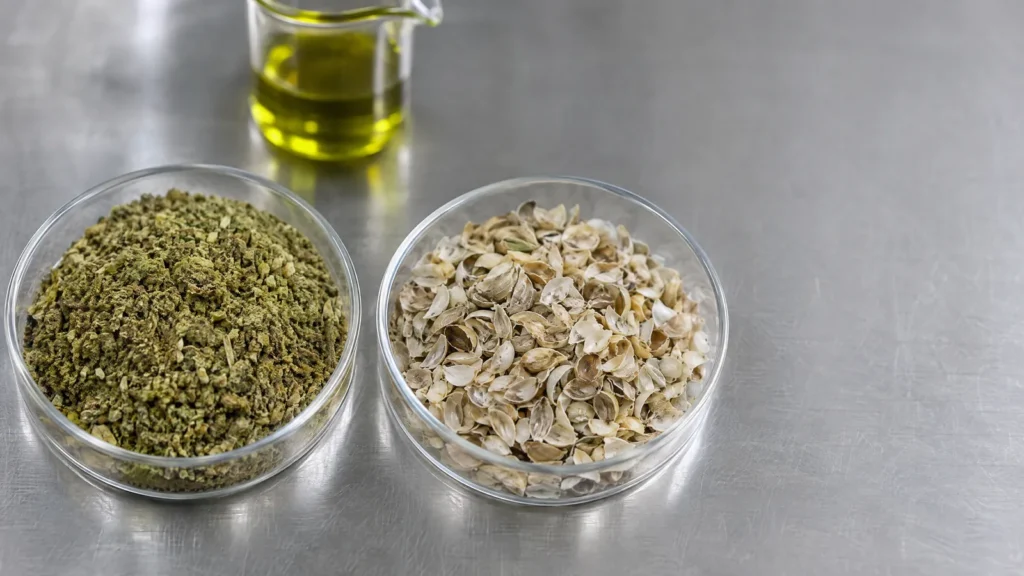
Hemp seed oil is not a protein source and not a fibre source, so it can’t stand in for hemp hearts or hempseed shells in a ration. It’s a fat, and should be costed and specified as one.
| Energy | 3761 kJ / 899 kcal |
| Fat | 99.76 g |
| of which saturates | 10 g |
| of which monounsaturates | 9.4 g |
| of which polyunsaturates | 79.5 g |
| Moisture, maximum | 0.5 % |
What fatty acid profile should you expect?
Expect a profile dominated by linoleic acid, with alpha-linolenic acid as the second fatty acid and only trace amounts of anything else. The shape holds across varieties and origins.
The comparison that matters commercially is with flaxseed oil, because that is what a formulator usually has in front of them when they consider hemp. Hemp carries more polyunsaturates overall, around 76 percent against roughly 66 percent for flax, and it is the only one of the two with gamma-linolenic acid. Flax, on the other hand, delivers more alpha-linolenic acid per kilogram. If your goal is the highest possible omega-3 number on the label, flax wins. If your goal is a broader fatty acid spread in a pleasant tasting oil, hemp is the better fit.
Published figures put hempseed oil above 80 percent polyunsaturates (Callaway, Euphytica, 2004). Other sources put it nearer 76 percent, and our own analysis of the oil we sell reads 79.5 grams per 100. Variety and pressing move the number, which is why a certificate beats a textbook figure.
A certificate from one batch is evidence about that batch, not a permanent property of the category. Ratios are easy to quote and hard to verify, which is why the profile belongs in your supplier specification rather than in your marketing copy.
Dogs, cats and horses: what changes by species
The oil does not change. What changes is how much of it the animal can use, and what the rest of the ration has to supply.
Dogs
Dogs are omnivores with a mixed digestive strategy, and they handle plant oils well. Hemp seed oil fits comfortably as part of the added fat in complete food, in treats, and in supplement formats where the oil is the carrier. The practical limit is the fat ceiling of the product and the palatability curve: beyond a certain point more oil stops improving intake and starts softening kibble or turning a treat greasy.
The closest published trial in dogs used the cake rather than the oil. Vastolo and colleagues fed eight healthy crossbreed dogs a commercial diet supplemented at 3.5 percent with either swine tallow or hempseed cake for 30 days. The hemp group finished with lower cholesterol, AST, ALT, creatinine and creatine kinase than the tallow group. The authors call the result preliminary: eight dogs, one month, and no analysis of how those fatty acids behaved after absorption. It is the best evidence there is for hemp in a dog diet, and it is not evidence about the oil.
Cats
Cats are obligate carnivores, and their fat requirement is built around animal fat. They also convert alpha-linolenic acid into the long-chain omega-3 fatty acids poorly, which is the standard position in cat nutrition. A plant oil therefore contributes less to that side of the requirement than a marine source does. Hemp seed oil still works as an energy source and as a source of linoleic acid, but it does not replace animal fat in a cat formulation, and any supplier who suggests otherwise is overselling.
Horses
Horses are where the published evidence is thinnest. The most useful summary comes from Kentucky Equine Research, which states plainly that it has not found studies in which hemp was actually fed to horses, alone or against other feedstuffs. What is known is compositional. Hemp oil carries around 76 percent polyunsaturates against roughly 66 percent for flax oil. It supplies gamma-linolenic acid that flax does not, and hemp meal offers slightly less lysine but more methionine than soybean meal.
Fair ground for using hemp oil as a fat source in an equine ration. We do not claim a training effect, a joint effect or a calming effect.
How much hemp seed oil goes into a formulation?
We don’t publish a recommended inclusion rate, and you should be suspicious of any supplier who does without seeing your recipe. The number depends on four things you control.
- Your fat ceiling. The declared fat on the finished product is a ceiling, not a target. Whatever share of it the oil takes, the rest of the formula has to give up.
- Whether it replaces or adds. Replacing part of an existing fat keeps the energy density stable and changes the fatty acid profile. Adding it raises energy density, which then has to be rebalanced against protein and starch.
- The rest of the fatty acid picture. If the formula already carries fish oil or a marine source, hemp oil is competing for the same declaration space.
- Process tolerance. Coating, mixing and storage all set a practical upper limit well before nutrition does.
The way to settle it is arithmetic on your own declared analysis. Take the fat ceiling, decide the share the oil will carry, and check that the fatty acid declaration still adds up. Your nutritionist signs that off, not your supplier.
Why does hemp seed oil go rancid?
Because it is mostly polyunsaturates, and polyunsaturates react with oxygen. The double bonds that make the oil nutritionally interesting are also the points where oxygen attaches, and once that starts the oil moves from nutty to stale to a smell that nobody wants near a pet food plant. Peroxide value and acid value are the two numbers that track it.
Oxidation usually starts before the seed is pressed. Hemp seed comes off the combine wet enough to spoil, so drying starts immediately. Our dryers are indirect fired, so combustion gas never touches the seed, and the ceiling is 45 to 50 degrees Celsius. Above 50 degrees the seed coat cracks, oxygen reaches the kernel underneath, and the oil starts to age in the store. Pressing later cannot undo that, which is why we treat the drying limit as an oil quality parameter and not as a drying detail.
The same conclusion comes from the dog trial. The hemp diet carried a higher peroxidation index than the tallow diet it replaced, and the authors say plainly that diets high in polyunsaturates have to be protected from light and high temperature during production and storage. That is the same answer our dryer gives us, arrived at from the other end of the chain.
Each incoming lot runs through a small-scale dehulling trial and a colour check before it is committed to the line. Polycyclic aromatic hydrocarbons are tested on incoming material, and a lot whose PAH sum exceeds 10 doesn’t go into food use. Raw seed sits on pallets under cover, below 15 degrees Celsius, away from light.
What we can put on paper today is the process behind the lot, not a fatty acid and oxidation panel for every delivery. If your specification needs a number per delivery, ask for it before you book and we’ll tell you exactly what is available for that batch. That conversation costs less than discovering the gap at goods-in.
Where our oil comes from
The oil is cold pressed and organic, certified under EU Organic EE-ÖKO-03, and the plant operates under BRCGS certification. The oil is non-GMO, no ionising radiation is used at any stage, and moisture is held at or below 0.5 percent.
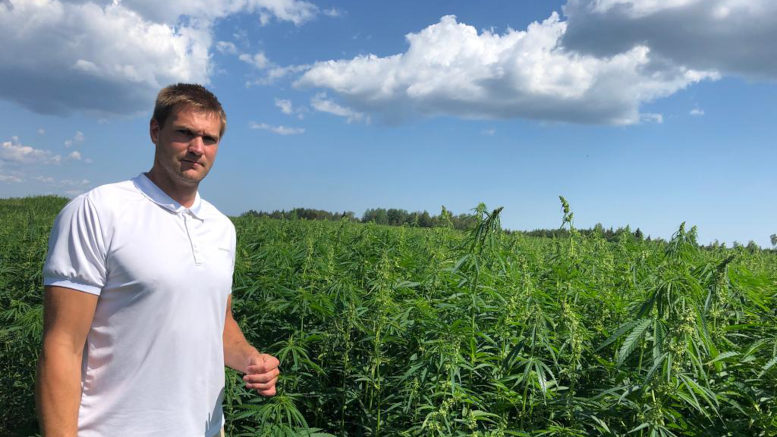
The seed is Estonian and comes from our own growers, who farm around 5,000 hectares of hemp a year. Every tonne that arrives is processed into finished ingredients, and raw seed is not resold. The oil comes off a line that exists to make food. Intake runs through our warehouse in Mustvee, a 3,000 square metre site, and processing through the plant in Vahi, 1,500 square metres. Oil capacity is around 300 tonnes a year.
If you want the documentation side in more detail, it sits on our quality and certifications page.
How do you compare two quotes for the same oil?
Two quotes for what sounds like the same product rarely describe the same material. Pressing temperature, moisture, oxidation numbers, packaging, shelf life, certification scope and traceability are what separate them. If you are choosing a supplier rather than comparing this oil with another fat, our bulk hemp seed oil sourcing guide walks through the same points at more length.
| Pressing temperature | Cold pressed is a claim about heat exposure. Ask what the temperature actually was. |
| Moisture | Water drives hydrolysis and shortens shelf life. Ours is held at or below 0.5 percent. |
| Oxidation numbers | Peroxide value and acid value are the only honest measure of how the oil has aged so far. |
| Packaging | Drum and IBC behave differently in transit. Ours ships in 1000 L IBC. |
| Shelf life and storage | A shelf life without storage conditions is not a shelf life. |
| Certification scope | Organic and BRCGS certificates have a scope. Check that your product is inside it. |
| Traceability | Lot number on the packaging, and a record that runs back to the field. |
What can you legally claim on the pack?
In the European Union, claims on feed materials and compound feed are governed by Regulation (EC) No 767/2009, Article 13.
Article 13 allows the labelling to draw attention to the presence of a substance, to a specific nutritional characteristic, or to a function related to either. The claim has to be objective, verifiable by the competent authority, and understandable by the user of the feed. It also requires that the person responsible for the label can produce scientific substantiation at the request of the authority, and that this substantiation exists at the moment the feed is placed on the market. A claim you cannot back with a file is a claim you should not print, so keep the reasoning, the references and the internal sign-off together.
Paragraph 2 permits claims about optimising nutrition and about supporting or protecting physiological conditions. Paragraph 3 draws the line: the labelling may not claim that the feed will prevent, treat or cure a disease.
| Treats itchy skin | Supports skin and coat condition |
| Relieves joint pain | Contributes to normal joint function |
| Prevents inflammation | Source of omega-3 alpha-linolenic acid |
| Calms anxious animals | Supports normal behaviour in stressful situations |
| Good for arthritis | Source of essential fatty acids |
On top of the labelling rules, hemp seed oil is a listed feed material in the EU catalogue, entry 2.22.3 of Regulation (EU) 2022/1104. The catalogue entry is the cleanest description for a specification: a named feed material, not a novel ingredient.
Packaging, shelf life and shipping
| Product | Cold-pressed organic hemp seed oil, feed grade |
| Certification | EU Organic EE-ÖKO-03, BRCGS |
| Packaging | 1000 litre IBC |
| Shelf life | 18 months from packing |
| Storage | Cool, dry, dark, away from walls |
| Moisture | 0.5 percent maximum |
| Origin | Estonia |
The oil ships in 1000 litre IBC containers. Shelf life is 18 months from packing, held in cool, dry conditions, protected from sunlight and away from walls so air can move around the container. Every unit carries the product name, the ingredient statement, the net weight, the lot number, the best before reference, the organic logo, our address and the country of origin, Estonia.
We ship worldwide. For most buyers the practical question is not the shelf life on paper. What matters is the temperature the container sees between our loading bay and your tank. Tell us the route and we will say what we would expect at the other end.
If you are still working out which hemp ingredient belongs in which product, start with the feed cluster. Smoothie hemp covers the kernel fraction and hempseed shells cover fibre. There is a direct comparison with soybean hulls, beet pulp and wheat bran if you are weighing fibre sources against each other.
Frequently asked questions
Can hemp seed oil be used in dog food?
Yes. Hemp seed oil is a listed feed material in the EU and is used in dog food as a source of fat, energy and essential fatty acids. The inclusion rate depends on the fat ceiling of the product and on the rest of the recipe, so it is set by the nutritionist formulating the food rather than by the oil supplier.
Is hemp seed oil suitable for cats?
It can be used, but it plays a smaller role than in dog food. Cats are obligate carnivores and their fat requirement is built around animal fat, and they convert alpha-linolenic acid into long-chain omega-3 fatty acids poorly. Treat hemp seed oil as a partial fat source and keep animal fat in the formula.
What is hemp seed oil used for in animal feed?
As a fat source. It raises energy density, supplies linoleic and alpha-linolenic acid, and improves palatability through its nutty aroma. Pet food makers use it in complete food, in treats, in supplements and in equine rations, usually replacing part of the added fat rather than adding to it.
How much hemp seed oil should be added to pet food?
There’s no single number. Work from the declared fat ceiling of the finished product, decide what share of that fat the oil will carry, and check that the fatty acid declaration still adds up. A supplier who quotes a percentage without seeing your recipe is guessing.
Does hemp seed oil help with coat and skin?
It supplies linoleic and alpha-linolenic acid, which are essential fatty acids the animal cannot make itself, and skin and coat condition is the physiological function they are associated with. Under EU feed labelling rules a claim of support for skin and coat condition is permitted if it is substantiated. A claim that the product treats a skin problem is not.
How should hemp seed oil be stored?
Cool, dry and dark, away from walls so air can move around the container. Hemp oil is high in polyunsaturates and oxidises faster than saturated fats, so heat and light shorten its useful life. Our shelf life is 18 months from packing when those conditions are met.
Can hemp seed oil replace fish oil in pet food?
No, not on the long-chain omega-3 side. Hemp seed oil supplies alpha-linolenic acid, while fish oil supplies EPA and DHA directly. Dogs can convert some alpha-linolenic acid into the longer chains, cats do it poorly, and horses have their own limits. Hemp oil is a useful fat and a source of essential fatty acids, but it is not a substitute for a marine source where EPA and DHA are the target.
Request the specification
Tell us the application, the volume and the analysis you need, and we’ll send the specification and a sample. If your product is already on the market, send the recipe constraints and we will tell you where the oil fits and where it does not.
Contact Nordic Hemp See the product specificationSources
Sources used for the composition and market claims in this article.
- Hemp for Horses. Kentucky Equine Research, Equinews. ker.com.
- Regulation (EC) No 767/2009 on the placing on the market and use of feed, Article 13. EUR-Lex consolidated text.
- Commission Regulation (EU) 2022/1104 amending Regulation (EU) No 68/2013 on the Catalogue of feed materials.
- Callaway, J.C. Hempseed as a nutritional resource: an overview. Euphytica 140, 65-72 (2004). Springer.
- Vastolo, A. et al. Hemp Seed Cake as a Novel Ingredient for Dog’s Diet. Frontiers in Veterinary Science 8:754625 (2021). Frontiers.