Feeding Laying Hens Hemp Cake: What the Evidence Shows
Last updated: November 12, 2026
Laying hens are the one poultry category where hemp has been tested properly, and the results are unusually clean. A 2026 trial fed 30 percent hemp cake to organic layers for 16 weeks and found no loss in production, with a better fatty acid profile in the yolk.
This article sets out what has been tested, what the numbers were, and where our own fractions fit. It also says plainly where the evidence stops.
Hemp cake at 30 percent of the diet produced no significant difference in laying performance, egg weight or egg mass over 16 weeks, and it raised polyunsaturated and omega-3 fatty acids in the yolk while lowering the omega-6 to omega-3 ratio. Whole hempseed has been tested at 10 and 20 percent and hempseed oil at 4 to 12 percent. Smoothie hemp has no layer trial, so it belongs in a ration as a tested-by-you ingredient, not as a proven one.

Which hemp fractions can go into a laying diet?
| Fraction | What it is | Layer evidence |
|---|---|---|
| Hemp seed cake | Pressed meal; about 33% crude protein in a published US reference, not our own specification | Tested at 30% of the diet |
| Whole hempseed | The seed with its coat, high in fat | Tested at 10 and 20% |
| Hempseed oil | A concentrated fat source | Tested at 4, 8 and 12% |
| Smoothie hemp | Dehulling fines, 30.3% protein and 38.4% fat in our analysis | No published layer trial |
| Hempseed shells | The coat, a fibre material with little energy | No layer use, and a poor fit |
| Hemp protein | Concentrated protein from the seed | No layer-specific data found |
Read the certificate against this table with our guide to reading a hemp feed analysis.
The fractions with evidence are the ones where the fat is moderate and the protein is high. The fractions with the most fat are the ones with the least data, and that is not a coincidence: fat is what limits a laying ration.
What does the hemp cake trial show?
The reference study is a 2026 trial published in the Journal of Agriculture and Food Research, run with organically reared layers. Two hundred and eighty Hy-Line Brown hens were enrolled at 18 weeks of age and split into two treatments, each with two pens of 70 birds.
The control diet was built on sunflower cake and soybean as the main protein sources. In the hemp diet, part of those ingredients was replaced with 30 percent locally produced hemp cake. Data were collected over 16 weeks after an adaptation period.
| Measure | Result at 30% hemp cake |
|---|---|
| Laying performance | No significant difference detected |
| Egg weight | No significant difference detected |
| Egg mass | No significant difference detected |
| Yolk fatty acids | Higher polyunsaturates, higher omega-3 |
| Omega-6 to omega-3 ratio | Lower |
| Egg physical traits | Largely unaffected |
| Sensory assessment | Authors report acceptability largely unaffected |
| Hen behaviour | No difference in the measures recorded |
One caveat on the design: each treatment had two pens of 70 hens, so the pen is the experimental unit and the comparison has two replicates per treatment. That is a low-powered design for a production measure, and the honest reading is that no difference was detected, not that a difference was ruled out. Thirty percent is also a high inclusion for a by-product, and the trial was designed to test a local organic supply chain rather than to find a maximum. Read it as proof that the material does not break a laying ration, not as a recommended level.
What do hempseed and hemp oil do to the yolk?
A 2012 study in the Journal of Food Science fed 48 individually caged Bovans White hens one of six diets for 12 weeks: 4, 8 or 12 percent hempseed oil, 10 or 20 percent whole hempseed, or a control with no hemp. Six diets across 48 birds means eight hens per diet, so every figure from that trial is a small-group estimate.
Total omega-3 polyunsaturated fatty acids in the yolk were highest at the 12 percent oil level, which is the top of the range tested and not a recommended dose. It is what you would expect when you feed a fat that is itself rich in alpha-linolenic acid. The study also scored sensory attributes, because eggs with a raised omega-3 content have a reputation for off-flavours that the work has to answer for.
An earlier study in the Journal of Chemistry reported changes in yolk cholesterol and fatty acid composition when hemp seed was fed to Rhode Island Red cross hens. The direction of travel across the published work is consistent: the yolk composition moves, and the egg itself holds up.
Where does smoothie hemp fit?
To our knowledge there is no published laying trial on dehulling fines, and we are not going to invent one.
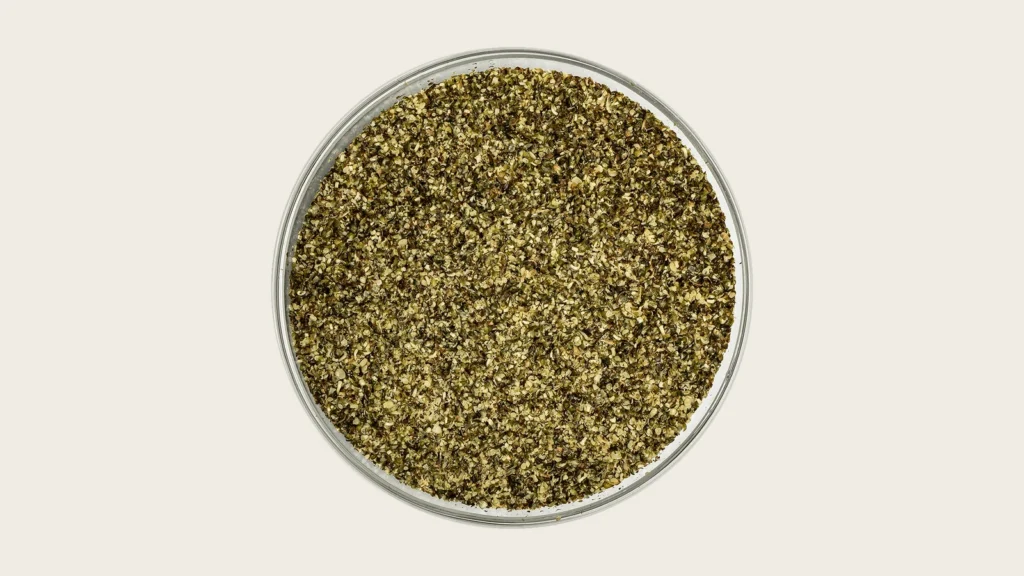
What we can say is compositional, and it is about one lot. Smoothie hemp is the dehulling fines fraction we sell in bulk; on the lot we sent to the laboratory it carried 30.3 percent protein, 38.4 percent fat and 17.0 percent fibre. Hemp seed cake is a different material, leaner because the oil has been pressed out. Whole seed is different again, because it carries the oil and the coat together.
Smoothie hemp therefore sits between cake and whole seed: more fat than cake, more fibre than whole seed, and a protein content close to cake. Layers tolerate a higher fibre level than broilers, and a layer’s energy target is lower than a broiler’s, so a moderate share of a fat-rich ingredient can fit inside it. The limit is not fat as such, it is what fat displaces: every point of energy from oil is a point of intake that no longer carries protein, amino acids and calcium. That makes a modest inclusion plausible and does not make it proven. A mill that wants to use it should run its own comparison on intake, egg weight and yolk colour, and start low.
Shells and protein in a laying diet
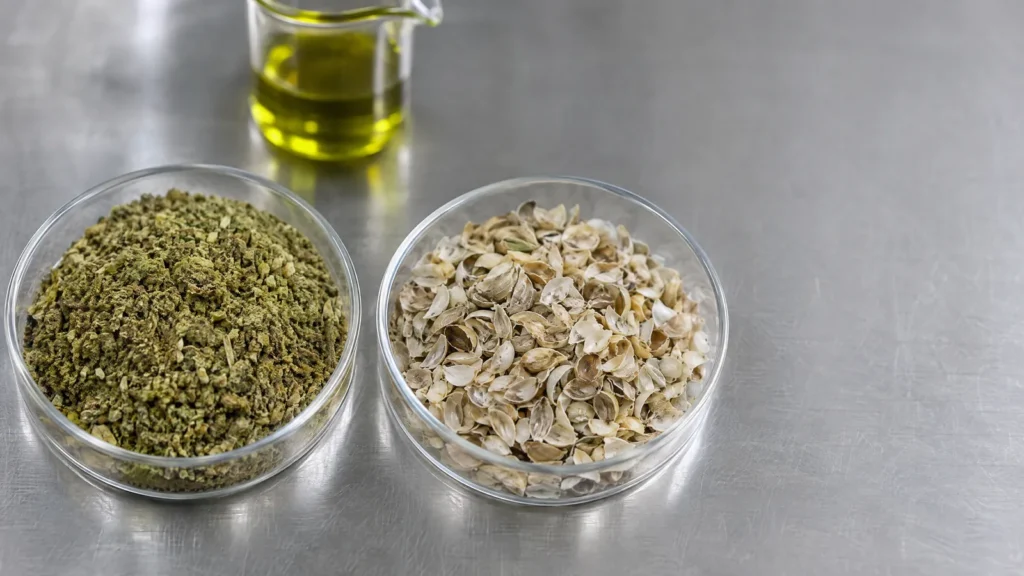
Hempseed shells are a fibre material with little energy, and a laying ration is built around nutrient density. Insoluble fibre does appear in layer diets at low levels, so we will not claim shells are unusable; we will say that we do not recommend them for layers, because fibre dilutes the density the flock is fed for. Their natural home is a ruminant ration, where rumen volume is the point.
Hemp protein concentrate is a different question. We sell it, and it is a sensible protein source on paper, but to our knowledge there is no layer-specific trial data on it. The poultry evidence we hold is on cake. Rather than stretch the evidence, we leave protein out of the layer recommendation and put it where the data is.
What to put in the specification
| Protein | Crude protein per lot, dry matter basis |
| Fat | The figure the press leaves, which sets the inclusion ceiling |
| Fibre | Crude fibre per lot |
| Oxidation | Peroxide and acid value, for anything carrying oil |
| Particle size | The grind your mixer handles |
| Organic status | EU Organic EE-ÖKO-03 certificate matching the lot |
Our plant holds EU Organic certification EE-ÖKO-03 and BRCGS certification (Brand Reputation through Compliance Global Standards), and the certificate that travels with an organic lot is the one that has to match it.
Frequently asked questions
Can hemp cake be fed to laying hens?
Yes. A 2026 trial replaced part of the sunflower cake and soybean in an organic layer diet with 30 percent hemp cake and detected no significant difference in laying performance, egg weight or egg mass over 16 weeks.
How much hemp cake can a layer take?
The published trial used 30 percent of the diet, which is high for a by-product. That is the level that was tested, not a recommendation, and the practical level depends on the energy and amino acid balance of your own ration.
Does hemp in the diet change the eggs?
The yolk fatty acid profile changes. Hemp cake raised polyunsaturated fatty acids and omega-3 in the yolk and lowered the omega-6 to omega-3 ratio, while physical egg quality and sensory assessment were largely unaffected.
Can I use whole hempseed instead of cake?
Whole hempseed has been tested at 10 and 20 percent of the diet, and hempseed oil at 4, 8 and 12 percent, in a 12-week trial with 48 hens. Whole seed brings more fat per kilo than cake, so the fat ceiling arrives sooner.
Is smoothie hemp tested in layers?
Not to our knowledge. We are not aware of a published layer trial on dehulling fines. It sits between cake and whole seed in composition, with more fat and more fibre than cake, and layers tolerate more fibre than broilers, so it is plausible at a modest inclusion. Plausible is not proven, and we say so.
Are hempseed shells useful for laying hens?
We would not position them for layers. Shells are a fibre material with very little energy, and a laying ration is already built around a nutrient density that fibre dilutes.
Is hemp protein a layer ingredient?
We have not found layer-specific trial data on hemp protein concentrate, so we do not make a feed recommendation for it. The protein evidence in poultry is on cake.
Ask about hemp cake for layers
Tell us the flock, the ration and the parameters you need, and we will send the specification and the analysis behind the lot on hand.
Contact Nordic Hemp See the hemp cake product pageSources
Sources used for the figures in this article.
- Integrating hemp cake in organic layer diets: a comprehensive assessment of egg quality, hen behavior, production costs, and life cycle impact. Journal of Agriculture and Food Research (2026). doi.org
- Goldberg E.M. et al. Fatty Acid Profile and Sensory Characteristics of Table Eggs from Laying Hens Fed Hempseed and Hempseed Oil. Journal of Food Science 77(4): S153-60 (2012).
- Konca Y. et al. Effects of heat-treated hempseed supplementation on performance, egg quality, sensory evaluation and antioxidant activity of laying hens. British Poultry Science 60(1): 39-46 (2018).
- Agricultural Utilization Research Institute. Opportunity for hemp in feed and pet food. Composition comparison of hemp cake, hemp hulls and conventional feedstuffs.
- Nordic Hemp laboratory analysis, GBA certificate 25308690-001, Smoothie 2.0 organic.