Hemp protein 50% – Your 100% plant-based powerhouse
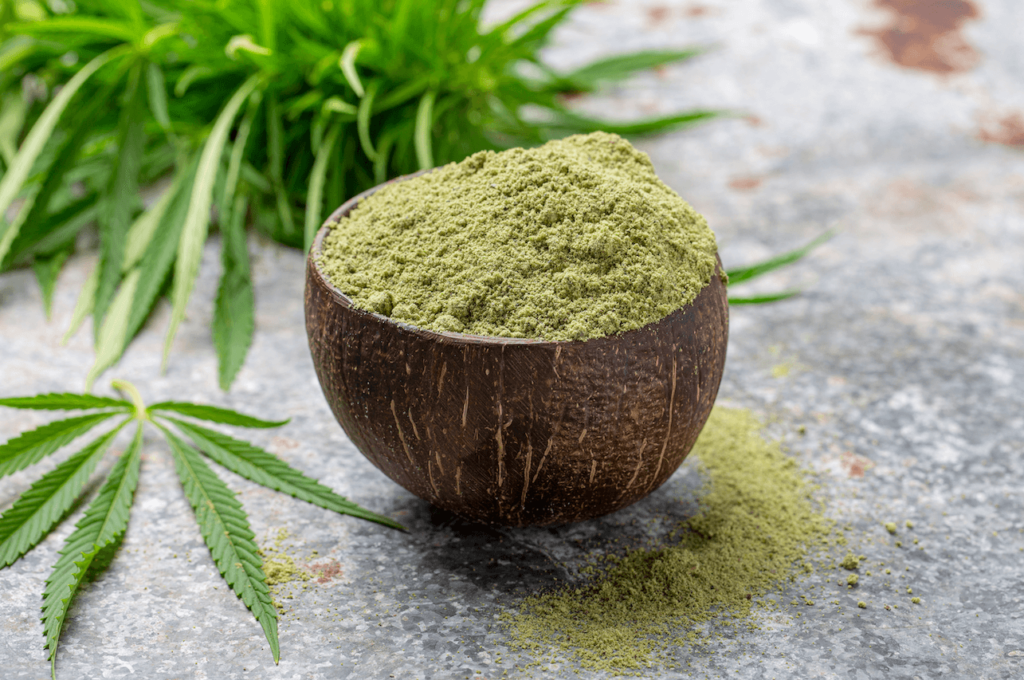

If you’ve been shopping for protein powder lately, you’ve probably noticed hemp popping up everywhere. And for good reason — our hemp protein 50% is about as clean as plant-based protein gets. Let’s dig into what makes it tick.
Maybe you’re an athlete trying to speed up recovery between sessions. Or someone who finally cut out dairy and needs a new go-to protein. Or you just want to eat more plants without feeling like you’re missing out. Hemp protein 50% fits all of those. In this guide I’ll walk through the amino acid profile, how it stacks up against whey and pea protein, and what to watch out for.
Hemp protein 50% is a mechanically milled hemp seed protein that packs 50g of protein per 100g with all nine essential amino acids. It’s naturally gluten-free, soy-free, and dairy-free with a mild nutty taste that blends easily into smoothies, shakes, and baked goods. THC and CBD are naturally present at trace levels, well below the EU limit of 3 mg/kg.
What is hemp protein and what makes it a superfood?
So what exactly is it? Our organic hemp protein 50% is made from hemp seeds — same plant family as cannabis, but we’re talking about the seeds, not the flowers. It’s milled into a fine powder and delivers all nine essential amino acids your body can’t make on its own. Plus it’s naturally gluten-free, soy-free, dairy-free, and non-GMO.
Hemp protein powder is a lot more concentrated than whole hemp seeds or hemp hearts: 50g of protein per 100g versus about 34g in hemp hearts. For a full breakdown of hemp hearts nutrition, see our complete guide to what makes hemp hearts so healthy.
| Per 100g | |
|---|---|
| Energy | 1359 kJ / 325 kcal |
| Fat | 13 g |
| Fibre | 5.4 g |
| Moisture | 8% |
| Protein | 50 g |
| Sugars | 4.9 g |
Nutritional information of hemp protein 50%
How well does your body actually absorb it?
Not all protein is created equal. There’s a metric called PDCAAS (Protein Digestibility-Corrected Amino Acid Score) that measures how well your body can actually use the protein you eat. Hemp scores around 0.5–0.66, depending on whether the seeds are hulled or not. That’s comparable to lentils and certain grains, and slightly lower than soy or whey.
Digestibility is another story. Research shows that 91–98% of the protein in ground hemp seed is digestible, thanks to two proteins called edestin and albumin that your body breaks down quickly. Cold-pressed hemp protein retains the highest digestibility.
Here’s what 100g of HP50 delivers:
| Amino Acid | Per 100g |
|---|---|
| Arginine | 4.3 g |
| Leucine (BCAA) | 3.1 g |
| Valine (BCAA) | 2.3 g |
| Isoleucine (BCAA) | 1.9 g |
| Phenylalanine | 1.8 g |
| Lysine | 1.5 g |
| Threonine | 1.3 g |
| Methionine | 0.8 g |
| Histidine | 0.7 g |
Arginine is the standout — it’s good for blood flow and recovery. The BCAAs (leucine, isoleucine, valine) are what your muscles need after a workout.
How does it taste and how can you use it?
One thing people mention a lot is how well this stuff blends. The texture is fine and the taste is mild — think nutty, not grassy or bitter. Stir it into water, oat milk, or yoghurt and it turns creamy. Toss it in a smoothie with a banana and you won’t even notice it’s there. Just don’t skimp on the liquid, the powder absorbs fast.
It works for baking too. Swap out about a quarter of the flour in any recipe for hemp powder and you’ve got a protein boost without changing the texture much. Because it’s 50% protein, a couple of tablespoons a day goes a long way.
If you’re vegan or just cutting back on animal products, this is an easy swap. Check out our recipe blog for some ideas to get started.
How healthy is hemp protein?
Here’s where hemp protein really stands out. It’s packed with omega-3s — most plant proteins have none. That matters for your heart and for keeping inflammation in check. It helps with muscle recovery, keeps things moving digestion-wise, and gives your immune system a solid boost. On top of that you get a good dose of magnesium, potassium, and zinc.
Also read our article on hemp seeds as a superfood and their benefits for a healthy diet and life.
What are the benefits of hemp protein?
So what can it actually do for you? Quite a bit, as it turns out.
Amino acids — the full set
Hemp has all nine essential amino acids. These are the building blocks your body uses to repair muscle, grow hair and nails, and keep your cells functioning. The catch? Your body can’t make them — you have to get them from food. Hemp protein makes that easy.
Unsaturated fatty acids
Most of us don’t get enough unsaturated fats. Hemp powder is loaded with them. The ratio of omega-6 to omega-3 in hemp seeds sits at a tidy 3:1 — considered pretty much ideal for human health.
Dietary fibre
You get a solid 5.4g of fibre per 100g from hemp protein. That helps with keeping your weight in check and lowers the risk of diabetes and heart disease — nothing flashy, just quietly useful.
Minerals and vitamins
HP50 brings magnesium, potassium, iron, zinc, and vitamins E, B1, and B6 to the table. Potassium and magnesium are great for heart health. Vitamin E and zinc act as antioxidants — they help protect your cells from everyday wear and tear.
Allergen-free
Because of its milk protein and lactose, whey protein can trigger digestive problems or be unsuitable for people with intolerances. Hemp protein doesn’t contain allergens, soy, gluten, or lactose and provides you with a lot of dietary fibre, which makes it a great alternative for allergy sufferers and people with lactose or gluten intolerance.
Eco-friendly and vegan
Hemp farming has a pretty light footprint. Growing hemp for protein produces way less CO2 than raising animals for whey. Our de-hulling facility in Estonia runs zero-waste, so nothing goes to landfill. And if you’re vegetarian or vegan, this is about as clean as protein gets — plants only, no compromises.
Hemp vs pea vs soy vs whey — how they compare
Short answer: depends on your needs.
| Factor | Hemp | Pea | Soy | Whey |
|---|---|---|---|---|
| Protein per 100g | 50g | 75-80g | 85-90g | 80-90g |
| Complete protein? | Yes | No | Yes | Yes |
| Fibre per 100g | 5.4g | ~2g | ~3g | 0g |
| Omega-3? | Yes | No | No | No |
| Allergen risk | Very low | Low | Moderate | High |
Pea vs hemp is a common question. Pea protein has more protein per gram but it is not a complete protein — it is low in methionine, one of the nine essential amino acids. Hemp protein contains all nine, plus fibre and omega-3s that pea protein lacks. For muscle building, pea is good when blended with rice protein; hemp works well as a complete daily protein source on its own.
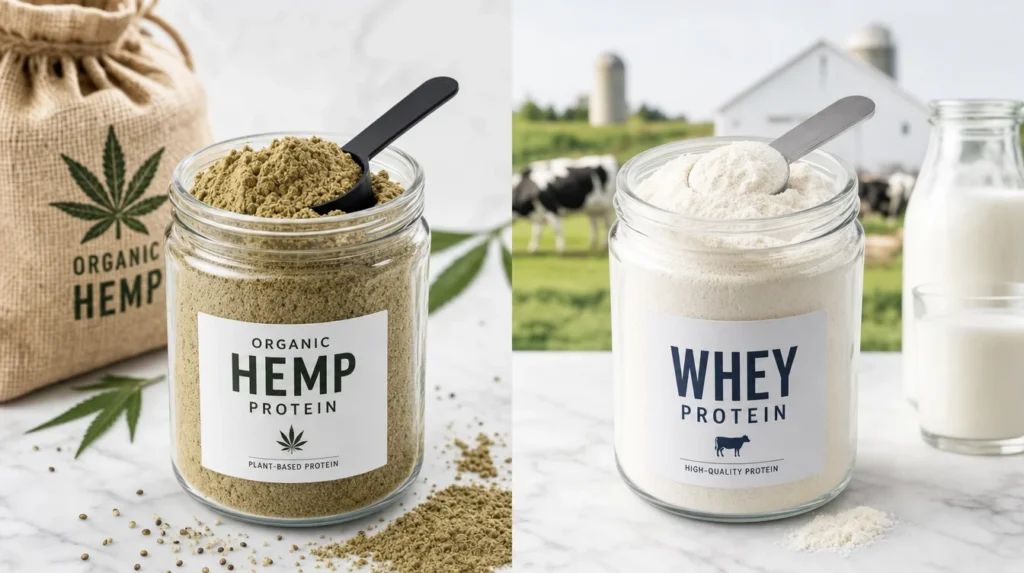
Hemp’s real strength is the full package: protein + fibre + omega-3s + low allergen risk. Whey is fast-absorbing and classic for post-workout, but it has no fibre, no omega-3s, and a lot of people feel bloated after it. Hemp is gentler on the stomach and works for everyday use.
A lot of people use both — whey right after a workout, hemp as a daily boost in smoothies or oatmeal.
Any downsides?
Hemp protein is safe for most people, but a few groups should be careful:
- Hemp seed allergy — rare, but if you have never tried hemp before, start small. Symptoms are similar to other seed allergies.
- Blood thinners — the vitamin E and omega-3s can have a mild blood-thinning effect. Check with your doctor if you are on anticoagulants.
- Digestive adjustment — the high fibre content can cause mild bloating or gas if you increase your intake too quickly. Start with one serving per day and increase gradually.
- Liver and kidney health — there is no evidence that hemp protein harms the liver or kidneys in healthy people. In fact, the arginine content supports liver function. Anyone with pre-existing liver or kidney conditions should consult their doctor before adding any new protein supplement.
- Calories — a serving is 30g, which provides 97 calories. Stick to the recommended serving size if you are watching your calorie intake.
And no — it won’t get you high. THC and CBD are naturally present at trace levels, well below the EU limit of 3 mg/kg.
If you are pregnant, nursing, or have a medical condition, check with your healthcare provider before adding any new supplement to your routine.
Common questions about hemp protein 50%
Is this the same as CBD?
No. Hemp protein is ground seeds. CBD comes from the flowers and leaves of the cannabis plant. Two completely different things from different parts of the plant.
Can you take it every day?
Yes. Hemp protein is a food ingredient, not a concentrated supplement. 30g a day is perfectly fine for most people.
Is hemp seed high in estrogen?
No — that’s a common myth. Hemp seeds don’t contain estrogen. They have lignans, plant compounds that can bind weakly to estrogen receptors, but no study has found meaningful hormonal effects from eating hemp seeds or hemp protein.
Does it have gluten?
Nope. Hemp is naturally gluten-free. Nordic Hemp’s HP50 is certified gluten-free.
How much hemp protein powder per day?
A typical serving is 30g (about 3 tablespoons), which gives you 15g of protein and 97 calories. Most people take one to two servings a day depending on their needs.
For food manufacturers
HP50 isn’t just for home kitchens. Food manufacturers across Europe use it in protein bars, plant-based meats, cereals, and baked goods. For bulk specs, certifications, and technical details, see our complete guide for food manufacturers.
Conclusion
If you want a plant-based protein that delivers a complete amino acid profile, packs in fibre and minerals, and doesn’t mess with your stomach — hemp protein 50% is worth a spot in your pantry. Mild nutty flavour, works in anything, no fuss.
Ready to stock up?
Nordic Hemp produces organic hemp protein 50% in Estonia. EU Organic certified, lab tested, available in 25 kg bags for manufacturers and in health food stores across Europe for consumers.
View product details